
You have 0 items in your cart
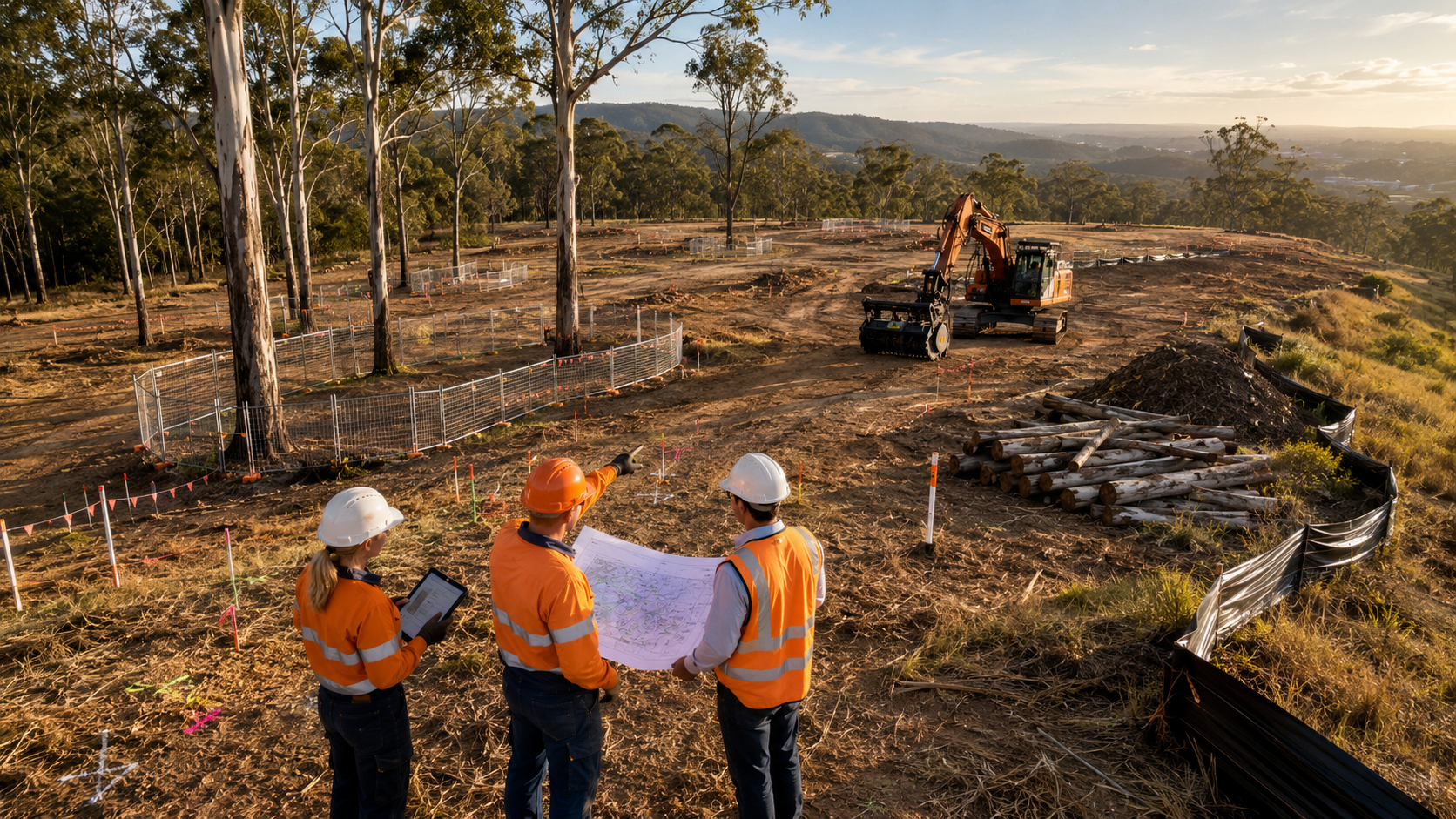
Every civil project across Brisbane and the Gold Coast lives or dies on the planning done before a single chainsaw fires up. A proper land clearing planning checklist Brisbane developers can actually follow is the difference between a project that runs to program and one that bleeds money through delays, fines, and rework. The contractors who hit program, stay on budget, and avoid stop-work notices share one thing in common — a proper land clearing planning checklist Brisbane civil contractors can rely on, — they treat land clearing planning as a structured discipline, not a phone call to the local arborist the week before the earthworks crew arrives. The ones who run over, get fined, or end up in court usually skipped a checklist item that would have cost them an hour to verify on paper.
This guide is the complete pre-clearing playbook for developers, civil project managers, and consultants planning land clearing across Brisbane, the Gold Coast, Logan, Ipswich, Moreton Bay, and the Scenic Rim. We cover the state and council regulatory framework, the AS 4970-2009 tree protection trap that catches three in ten development sites, equipment selection by terrain and vegetation type, biomass disposal economics, WHS documentation requirements, environmental compliance including koala habitat overlays and waterway buffers, and a comprehensive pre-clearing checklist you can take into your next site meeting.
Dynamic Tree Solutions has run civil-scale clearing across South East Queensland for over a decade. We see the same five planning failures appear on project after project — and we’ve written this guide so your project isn’t the sixth.
In This Guide
- Why Pre-Clearing Planning Saves Civil Projects Time and Money
- The Queensland Vegetation Management Framework Explained
- Local Council Requirements — Brisbane, Gold Coast, Logan, Ipswich, Moreton Bay, Scenic Rim
- Site Investigation — 10-Point Pre-Clearing Audit
- Underground Services Location — DBYD and Beyond
- Arboricultural Impact Assessment & AS 4970-2009
- Manual vs Mechanised Clearing — Decision Matrix
- Equipment Selection by Site Type
- Project Sequence — From Survey Peg-Out Through Final Earthworks
- Erosion and Sediment Control Planning
- WHS Documentation and Safety Compliance
- Environmental Considerations — Koala, Waterway Buffers, Fauna Spotters
- Bushfire APZ Management on Development Sites
- Biomass Disposal — On-Site vs Haul-Away
- 2026 Pricing & Budget Benchmarks
- The Complete Pre-Clearing Checklist
- Common Mistakes Developers Make
- Choosing a Land Clearing Contractor
- FAQ — Land Clearing Planning Brisbane & Gold Coast
Why Pre-Clearing Planning Saves Civil Projects Time and Money
The cost difference between a well-planned and a poorly-planned land clearing brisbane project on a 10-hectare site can exceed $200,000 once you factor in stop-work delays, retrospective approvals, machinery hire blowouts, sediment runoff penalties, and the cascading effect on earthworks scheduling. Planning isn’t paperwork — it’s risk management with numbers attached.
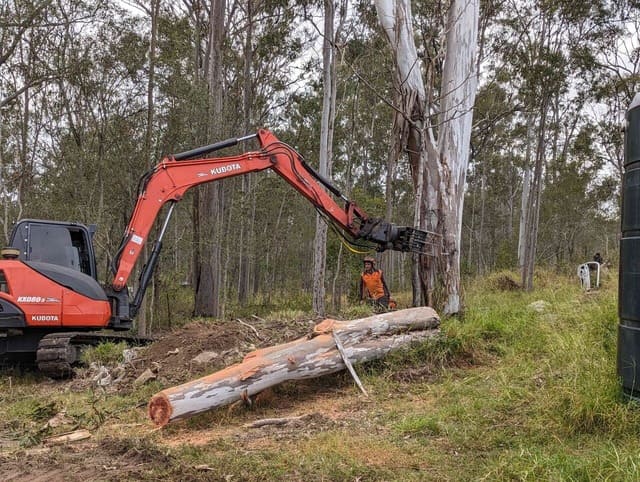
Three planning failures hurt land clearing planning checklist Brisbane projects the most. First, missing the vegetation overlay map and assuming clearing is exempt when it triggers a development approval. Second, ignoring the Tree Protection Zone calculations under AS 4970-2009 and killing retained trees through soil compaction during the earthworks phase. Third, underestimating biomass volumes and discovering at week two that the haul-away cost doubles the budget. A good commercial tree services contractor catches all three at the quoting stage.
Our companion article on civil works land clearing in Brisbane covers the equipment and execution side in detail — this guide focuses on what happens before the mulcher arrives on site.
The Queensland Vegetation Management Framework Explained
For any land clearing planning checklist Brisbane developers prepare, Queensland’s vegetation clearing rules sit across three layers: state legislation, the Planning Act, and local council overlays. Getting the layer hierarchy right is the first checklist item.
Land Clearing Planning Checklist Brisbane Step 1 — Vegetation Management Act 1999
The Queensland Vegetation Management Act 1999 (VMA) is the foundational law. It governs clearing on freehold and leasehold land, with particular focus on remnant vegetation as mapped on the regulated vegetation map. The Queensland Government vegetation clearing approvals page sets out which categories of clearing require approval and which are exempt.
For most metropolitan development blocks, the VMA is satisfied if the lot is already classified as cleared in the regulated vegetation map. But the moment a site borders mapped remnant vegetation, koala habitat, riparian corridor, or contains High Value Regrowth (HVR), state-level controls re-engage and the development application must address vegetation impact in detail.
Land Clearing Planning Checklist Brisbane Step 2 — Planning Act 2016 Pathway
The Queensland Planning Act 2016 sits above the VMA for any clearing tied to a development. Material change of use, reconfiguring a lot, or operational works that involve clearing all trigger development assessment. Whether your application is code-assessable or impact-assessable changes the public notification requirements and timelines dramatically.
Land Clearing Planning Checklist Brisbane Step 3 — Local Council Overlays
When building a land clearing planning checklist Brisbane and Gold Coast projects can use across the region, remember that every council adds another layer of overlay maps and local laws on top of state legislation. Brisbane has the Natural Assets Local Law (NALL), Gold Coast has its own significant tree register and vegetation management code, Logan applies koala habitat overlays aggressively, and the Scenic Rim Regional Council applies rural-specific vegetation management overlays. Our consolidated council tree regulations guide covers each council’s framework with overlay map links.
Local Council Requirements Across South East Queensland
Brisbane City Council Land Clearing Planning Checklist Requirements
Brisbane’s Natural Assets Local Law (NALL) protects any tree with a trunk circumference of 40cm or greater measured at one metre off the ground — that’s a trunk diameter of about 12.7cm. The Significant Tree Register adds another tier of protection for specifically listed trees regardless of size. Vegetation overlays in the BCC City Plan 2014 classify biodiversity, waterway corridor, and ecological corridor zones. Our BCC tree regulations guide walks through the NALL thresholds, exemption pathways, and permit application process step by step.
Gold Coast City Council Pre-Clearing Checklist Requirements
The Gold Coast City Council vegetation management framework uses the City Plan 2016 along with a Significant Tree Register. Vegetation overlays apply heavily in foothill suburbs — Tallai, Worongary, Mudgeeraba, Bonogin — and along the Coomera, Nerang, and Tallebudgera river corridors. Land Clearing Approvals on the Gold Coast often need an arboricultural impact assessment from an AQF Level 5 consulting arborist to clear the development application phase.
Logan City Council Land Clearing Planning Considerations
Logan applies the strongest koala habitat protections in South East Queensland. The Logan City Planning Scheme overlays cover koala habitat values, waterway corridors, biodiversity, and significant landscape. Development in southern Logan suburbs — Jimboomba, Greenbank, Park Ridge, North Maclean — almost always triggers Koala Conservation Plan considerations. See our Logan council tree regulations guide for the overlay framework.
Ipswich, Moreton Bay & Scenic Rim Councils
Ipswich City Council runs the rapidly-growing Springfield, Ripley and Yamanto growth fronts, where remnant vegetation assessment frequently applies. Moreton Bay Regional Council enforces waterway buffer overlays aggressively along Pine River, Caboolture River and the coastal estuaries. Scenic Rim Regional Council applies bushfire-overlay vegetation management policies on rural and rural-residential zones. Each council has its own overlay map portal, application form, and assessment timeline — budget 6 to 12 weeks for code-assessable, 16 to 24 weeks for impact-assessable.
Site Investigation — The 10-Point Pre-Clearing Audit
Before a single dollar is spent on mobilisation, every civil site needs a structured pre-clearing checklist Gold Coast and Brisbane teams can execute consistently. The 10 points below are non-negotiable on any block over half a hectare. Skip one and you’re gambling with the program.
- Title and zoning verification. Lot/plan, current zoning, any easements or covenants registered on title.
- Vegetation map overlay check. State regulated vegetation map plus council overlay map. Identify any biodiversity, waterway corridor, koala habitat or significant vegetation overlay.
- Tree audit with mapped GPS positions. Every tree above council size threshold tagged, measured, condition-graded. Output is the input for the arboricultural impact assessment.
- Underground services locate. Dial Before You Dig 1100 plot covering electricity, water, sewer, gas, telco, NBN. Print and laminate for site induction.
- Site topography and access. Slope conditions, access road grade, machinery turning circles, neighbouring property setbacks.
- Drainage and waterway assessment. Existing drainage lines, watercourses (even ephemeral), buffer distances under council overlay.
- Bushfire hazard assessment. Bushfire Prone Area mapping, Asset Protection Zone (APZ) requirements under the Queensland Planning Act.
- Adjacent land uses. Schools, hospitals, retirement villages, koala habitat trees on neighbouring properties — all change the clearing scope.
- Environmental fauna assessment. Habitat trees, hollows, nesting evidence. Triggers fauna spotter-catcher requirement.
- Stockpile and laydown planning. Where will biomass sit during clearing? Where will retained mulch go after? Where will plant park overnight?
This pre-clearing audit feeds directly into the AIA, the development approval, the SWMS, and the contractor’s quote. Done well, it eliminates 80% of the surprises that derail clearing programs.
Underground Services Location — DBYD and Beyond
Hitting an underground asset during land clearing isn’t just expensive — it’s a notifiable safety incident that can shut your site for days while WorkSafe investigates. Before You Dig Australia (formerly Dial Before You Dig 1100) is the free national service that returns service plots from all member authorities. Lodge the request a minimum of two business days before mobilisation and a minimum of five business days before for complex sites.
The DBYD plot doesn’t catch everything. Private services on the property — irrigation, garden lighting, septic field, water tanks, owner-installed conduits — aren’t on any database. For high-risk sites (hospitals, schools, industrial precincts) you’ll also want to engage an electromagnetic locating service to physically trace and mark services with paint or stakes. Aerial overhead services from Energex need separate clearance management — trees within the regulated clearance envelope require a Live Work Permit and Energex-accredited operators.
Arboricultural Impact Assessment & AS 4970-2009
Within your land clearing planning checklist Brisbane approvals stage, if your development application includes any retained trees — even just one boundary tree — AS 4970-2009 Protection of Trees on Development Sites applies. This Australian Standard is cited in nearly every SEQ council DA as the default benchmark for tree protection.
Land Clearing Planning Checklist Brisbane — Tree Protection Zone (TPZ) and SRZ Calculations
The TPZ is calculated as 12 times the Diameter at Breast Height (DBH), capped at 15 metres. So a 50cm DBH tree gets a TPZ radius of 6 metres — that’s a 113 square metre no-touch zone around every retained tree. Inside the TPZ: no soil compaction, no root disturbance, no machinery movement, no fuel storage, no stockpiles. The Structural Root Zone within the TPZ — calculated separately based on tree size — is an absolute no-touch zone.
The AIA Report Contents
A council-ready Arboricultural Impact Assessment must include: tree schedule with species, DBH, height, condition, retention value rating; site plan overlay with TPZ/SRZ marked on each retained tree; impact discussion for proposed works inside TPZs; tree protection methodology including fencing, root mapping, and supervision requirements; and recommendations for tree health monitoring during construction. Our arborist reports Brisbane service delivers AIAs from $1,800 for residential infill up to $8,000+ for complex commercial sites.
Manual vs Mechanised Clearing — The Decision Matrix
The clearing method drives the clearing cost, the program length, and the biomass disposal pathway. Three categories cover 95% of civil work in South East Queensland.
- Manual climbing crews — For tight-access sites, infill development, work within retained tree TPZs, work near power lines, or anywhere machinery can’t access safely. Slower and more expensive per tree but the only option in many constrained sites. Typical rate $1,500–$8,000 per tree depending on complexity.
- Mechanised forestry mulching — For open paddock and low-density bushland under 35cm DBH. Forestry mulchers convert standing vegetation to on-site mulch in a single pass. Fastest method on large blocks, eliminates haul-away cost. Typical rate $2,000–$8,500 per hectare.
- Excavator + grapple saw + mulching head — For mixed-density sites with larger timber. A 20-tonne excavator with a mulching head handles trees up to 60cm DBH; with a grapple saw it can fell, position and process larger specimens. Best all-rounder for civil clearing.
Pure forestry mulching only works up to 35cm DBH. Above that, the productive solution is excavator-mounted equipment or manual climbing-rigging. The trap on civil sites is quoting forestry mulching when the actual vegetation density and stem-size mix needs excavator support — you’ll discover this on day two when productivity halves.
Equipment Selection by Site Type
Matching plant to site is what separates a five-day job from a three-week job. Use this matrix as a starting point:

- Open paddock under 1 ha, light vegetation — Skid steer with mulching head. Manoeuvrable, single-day mobilisation.
- 1–5 ha, mixed light/moderate vegetation — Tracked skid steer with mulcher + chainsaw crew for larger stems.
- 5–20 ha, moderate to dense vegetation — Forestry mulcher (large tracked carrier) + excavator with mulching head. Possibly a second excavator for stockpile management.
- 20+ ha, heavy native timber — Multiple mulchers, excavators with grapple saws and mulching heads, dedicated stump grinding crew, support truck for biomass haul.
- Tight infill or retained tree work — Manual crews with climbing systems, rigging gear, EWP (cherry picker) where access allows. Possibly crane-assisted for hazardous removals near structures.
- Bushfire APZ maintenance — Slasher or skid steer with brush cutter for ongoing programmes.
For complex hazardous removals on civil sites — trees through power lines, leaning trees over retained structures, dead trees with structural compromise — specialist hazardous tree clearing teams use sectional dismantling and crane-assisted methods. Always carve this out as a separate scope item rather than wrapping it into the general clearing rate.
Project Sequence — From Survey Peg-Out Through Final Earthworks
On every civil clearing job, one ordered workflow consistently delivers: survey peg-out first, services located, fencing and protection installed, clearing, stump grinding within earthworks footprint, then earthworks. Three sequencing failures show up repeatedly on land clearing planning checklist Brisbane projects:
- Clearing before survey peg-out. The clearing contractor takes out a tree that turns out to sit on the wrong side of the boundary. Best case: an angry neighbour and a replanting bill. Worst case: a council compliance notice.
- Clearing before services located. The mulcher hits a 250mm water main. Site shut for two days, plumber bill, council inspection.
- Earthworks before stump grinding. The earthworks plant compacts soil over uncleared stumps and root systems, requiring rework when the slab pour reveals the void below.
For complex sites, lock the sequence in a formal Site Establishment Plan signed off by the principal contractor, the civil engineer, and the clearing contractor. Walk it through together before any tree comes down.
Erosion and Sediment Control Planning
Removing vegetation exposes soil. Exposed soil in a Queensland wet season can move tonnes of sediment off-site in a single rain event — into stormwater drains, onto roads, into waterways. Council and the EPA take sediment runoff seriously, with enforcement powers under the Environmental Protection Act.
Every land clearing planning checklist Brisbane and Gold Coast project needs a compliant Erosion and Sediment Control Plan (ESCP) in place BEFORE clearing starts. The ESCP includes: stabilised entry/exit point (rumble strip or rock pad); sediment fences along downslope boundaries; sediment basins or traps sized for the site catchment; stockpile management protocols; check dams in disturbed swales; and a maintenance schedule with inspection records.
On-site forestry mulching produces an immediate co-benefit here — the mulch becomes erosion-control groundcover for the disturbed surface, dramatically reducing sediment generation during the earthworks phase. This is one of the biggest practical reasons to favour mulching over haul-away on most civil sites.
WHS Documentation and Safety Compliance
Civil clearing is high-risk construction work under WorkSafe Queensland regulation. The contractor delivering on your site must produce, before mobilisation:

- Site-specific Safe Work Method Statements (SWMS) for every high-risk activity — chainsaw operations, EWP work, work near power lines, mechanical clearing, rigging
- Job Safety and Environmental Analysis (JSEA) tied to the SWMS
- Plant pre-start inspection records for every piece of equipment
- Toolbox talk records and crew induction records
- Current $20M public liability insurance and workers compensation certificates
- AQF Level 3 minimum for production crews; AQF Level 5 for any consulting work
- Compliance with Arboriculture Australia industry safe work practices and AS 4373-2007 (Pruning of Amenity Trees)
Dynamic Tree Solutions runs Tier 1 safety and compliance documentation across every civil clearing project. Crews are AQF qualified, fleet is owned and maintained, and we deliver project-specific WHS documentation as a contract deliverable rather than an afterthought.
Environmental Considerations — Koala, Waterway Buffers, Fauna Spotters
Koala Habitat
Queensland’s Koala Conservation Plan and the federal Environment Protection and Biodiversity Conservation Act (EPBC) impose serious controls on clearing within mapped koala habitat. Logan, Redlands, Moreton Bay, and parts of the Gold Coast carry koala habitat overlays that may require referral to the state Department of Environment and Science or federal approval under the EPBC Act if listed threatened species are affected.
Waterway Buffers
Most SEQ councils require 20-metre buffers from any mapped waterway, with stronger requirements for higher-order streams. Clearing within waterway buffers triggers additional development assessment and may require state referral under the Water Act. The buffer applies even to ephemeral streams (which only flow after rain) if mapped on the council overlay.
Fauna Spotter-Catcher
Within a comprehensive land clearing planning checklist Brisbane audit, sites with mapped fauna habitat, habitat trees with hollows, or recent nesting evidence may require a licensed fauna spotter-catcher to be on site during clearing. The spotter-catcher physically checks each tree before felling, relocates any fauna found, and documents the protocol. Budget $1,200 to $2,500 per day for a licensed operator.
Bushfire APZ Management on Development Sites
Sites in mapped Bushfire Prone Areas require an Asset Protection Zone (APZ) around new structures. The APZ is typically a 20-metre inner zone of managed low fuel-load vegetation around the building footprint. For development applications, the APZ specifications come from the Queensland Fire and Emergency Services bushfire mapping and the relevant council planning scheme.
For developers in Scenic Rim, western Logan, and Brisbane’s western suburbs (The Gap, Mt Coot-tha, Karawatha), APZ clearing is a routine part of the development pathway. When folded into your land clearing planning checklist Brisbane, it integrates with the broader clearing scope. Done badly, it becomes a separate $20,000 line item six months after handover.
Biomass Disposal — On-Site vs Haul-Away
Inside the land clearing planning checklist Brisbane biomass disposal step, a 5-hectare moderate-density block in SEQ produces 800–1,500 cubic metres of green waste biomass. That’s a serious logistics and cost question.
On-Site Mulching
Pros: zero haul-away cost, no truck movements, mulch becomes erosion-control groundcover, no tip fees, smaller carbon footprint, faster total program. Cons: requires receiving soil specification to accept mulch (most do), occupies surface that’s eventually built on (requires removal at slab phase, but typically much smaller volume by then).
Haul-Away
Pros: clean site for earthworks immediately, no biomass-related compaction issues, easier to deal with contaminated vegetation. Cons: $80–$150/tonne tip fees at licensed green waste facilities, truck movements (12 to 80 truck movements for a 5 ha block depending on biomass density), traffic management overhead, project carbon footprint.
For most civil sites, on-site mulching wins on cost. Where haul-away is necessary, ensure your contractor uses licensed green waste facilities and delivers weighbridge dockets for project records and EPA compliance.
& Budget Benchmarks
Per-Hectare Clearing Rates
- Light forestry mulching (open paddock, grass + light scrub) — $1,800 to $3,200/ha
- Moderate density clearing (mixed vegetation, some heavy timber under 35cm) — $4,500 to $8,500/ha
- Heavy clearing (mature eucalypt stands, dense bushland, large timber) — $8,000 to $15,000+/ha
- Very heavy/complex clearing (heritage trees, steep terrain, access issues) — Quoted per site
Specific Service Items
- Hazardous tree removal on civil sites — $1,500 to $8,000 per tree
- Stump grinding — $150 to $500 per stump
- Arboricultural Impact Assessment (small site) — $1,800 to $3,500
- Arboricultural Impact Assessment (large commercial DA) — $5,000 to $15,000+
- Fauna spotter-catcher — $1,200 to $2,500 per day
- Erosion and Sediment Control Plan — $1,500 to $4,000 (civil engineer)
- Council development approval fees — variable, $1,000 to $20,000+
- Tree protection fencing (per metre) — $25 to $40/m supplied + installed
Always include a site-specific quote step in your land clearing planning checklist Brisbane — based on a contractor walk-through, not a desktop estimate. Hectare rates vary widely with terrain, vegetation density, access, and disposal pathway.

The Complete Pre-Clearing Checklist
Print this. Take it to your next site meeting. Walk through every item.
Phase 1 — Desktop (Week 1)
- □ Title and zoning verified, easements/covenants checked
- □ State regulated vegetation map pulled and interpreted
- □ Council overlay map pulled (vegetation, biodiversity, waterway, koala, bushfire)
- □ Bushfire prone area mapping checked
- □ Development assessment pathway determined (exempt / code-assessable / impact-assessable)
- □ Preliminary clearing extent estimated
Phase 2 — Site Investigation (Weeks 2–3)
- □ Tree audit complete (GPS-mapped, condition-graded, DBH measured)
- □ Habitat tree inspection (hollows, nests, fauna evidence)
- □ AQF Level 5 arborist engaged for AIA
- □ Civil engineer engaged for ESCP
- □ DBYD lodged and plot received
- □ Private services located and physically marked
- □ Site access, machinery turning, stockpile zones identified
Phase 3 — Approvals (Weeks 4–16)
- □ AIA finalised and submitted with DA
- □ Development application lodged with council
- □ State referrals (vegetation, waterway, koala) lodged if required
- □ EPBC referral if listed species affected
- □ Permit conditions reviewed and accepted
- □ ESCP signed off by civil engineer
Phase 4 — Pre-Mobilisation (Week of clearing)
- □ Clearing contractor SWMS and JSEA received and reviewed
- □ Insurance certificates current
- □ Crew AQF qualifications verified
- □ Tree protection fencing installed around all retained TPZs
- □ Sediment fences and stabilised entry installed
- □ Stockpile zones marked
- □ Adjacent property owners notified
- □ Traffic management plan in place if road frontage affected
- □ Fauna spotter on site if required
- □ Energex permit if power line clearance required
- □ Site induction conducted with all crew
Phase 5 — Clearing Operations
- □ Daily pre-start inspections and toolbox talks
- □ Plant pre-start records maintained
- □ Erosion controls inspected daily, maintained as required
- □ TPZ fence integrity inspected daily
- □ Biomass managed per disposal plan
- □ Photographic records maintained
- □ Any incidents reported per principal contractor protocols
Phase 6 — Handover to Earthworks
- □ Stump removal within earthworks footprint complete
- □ Final clearing certificate issued by arborist
- □ Photographic survey of TPZ protection condition
- □ Weighbridge dockets filed if haul-away
- □ Site cleared of biomass to agreed level
- □ Council compliance reports filed
Common Mistakes Developers Make
- Treating land clearing planning checklist Brisbane as a single-phase event. It’s actually a six-phase process from desktop to handover. Skip phases and you create rework.
- Going with the cheapest quote without verifying SWMS, insurance, and AQF qualifications. Cheap clearing comes with expensive WHS exposure.
- Not getting an AIA. Even if council doesn’t explicitly require one, having an AIA in your project records protects you from disputes about retained tree health 18 months later.
- Underestimating biomass volume. Standing forest looks deceiving — the actual cubic-metre volume after chipping is typically 2–3x what you’d estimate by eye.
- Clearing before earthworks design is locked. Late design changes that affect cleared/retained boundaries become extremely expensive.
- Ignoring neighbour relations. A 15-minute conversation with adjoining owners before clearing avoids 95% of complaints.
- Not photographing TPZs before, during, and after. If a retained tree dies in 12 months, you’ll be asked for evidence of compliance.
Choosing a Land Clearing Contractor for Brisbane and Gold Coast Projects
The land clearing planning checklist Brisbane questions that filter the professionals from the chainsaw cowboys:
- Do you carry $20M+ public liability and workers compensation? (Show current certificates.)
- Are your consulting arborists AQF Level 5 qualified?
- Is your plant owned or hired? (Owned operators mobilise faster and run more reliably.)
- What’s your direct experience with this specific council’s permit pathway?
- Can you supply project-specific SWMS, JSEA, ESCP coordination, and compliance reporting?
- What’s the biomass disposal plan and what does it cost?
- Who is the project manager I’ll deal with daily?
- What’s your average mobilisation time?
- What’s your emergency response capability mid-project?
- Can I see three reference jobs of similar scale?
Dynamic Tree Solutions delivers land clearing across Brisbane and the Gold Coast with $20M public liability, AQF Level 5 consulting arborists, owned plant fleet, Tier 1 safety systems, and direct project experience with every SEQ council DA pathway. We provide free written quotes inside 48 hours of a site visit and project-specific clearing programs as a contract deliverable.
FAQ — Land Clearing Planning Brisbane & Gold Coast
How long does the approvals phase take? Code-assessable applications typically 6–12 weeks. Impact-assessable can run 16–24 weeks or longer with referrals. Engaging an AQF Level 5 consulting arborist early in the process is the single biggest accelerator.
Do I need an AIA for every site? If any trees are retained on the development site, yes. Even sites with no retained trees benefit from an AIA documenting the pre-clearing condition, particularly where neighbouring tree disputes might arise later.
Can I clear vegetation as a development applicant before approval? Only if the clearing is exempt under the council planning scheme and state legislation. Always confirm in writing with council before any tree comes down.
What’s the difference between forestry mulching and traditional clearing? Forestry mulching processes vegetation into mulch on-site in a single pass. Traditional clearing fells trees and removes biomass separately. Forestry mulching is generally faster and cheaper for moderate-density sites with stems under 35cm DBH.
How close to power lines can we clear? Within the Energex regulated clearance envelope, only Energex-accredited operators can work, and a Live Work Permit may be required. Plan power line clearance as a separate scope item with dedicated qualified crews.
What happens if I clear without permits? Significant fines (up to tens of thousands per tree), make-good orders, and potentially criminal prosecution under state legislation. Council enforcement is increasingly aggressive in SEQ growth corridors.
Can you fast-track an AIA for an urgent DA submission? Yes — we can typically turn around an AIA inside 10 business days from site visit for standard sites. Complex sites with multiple retained trees and detailed protection methodology may take 3–4 weeks.
Do you handle the council permit process for us? Our consulting arborists can prepare the technical components of the DA (AIA, vegetation impact statement, tree protection methodology) and work directly with the project’s town planner or council assessment officer to resolve queries. Talk to us early in the process for the smoothest outcome.
Talk to a Specialist About Your Civil Clearing Project
From land clearing planning checklist Brisbane through delivery and handover, Dynamic Tree Solutions runs civil-scale land clearing across Brisbane, the Gold Coast, Logan, Ipswich, Moreton Bay and the Scenic Rim. AQF Level 5 consulting arborists, $20M public liability, owned plant fleet, Tier 1 safety systems, and direct experience with every SEQ council development pathway.
Call 1300 239 626 or use the online quote form to book a site assessment. For arboricultural impact assessments, AIA reports are turned around inside two weeks of site visit. Need fast tree removal? Tree removal Brisbane mobilises within 48 hours. Read also our companion guide on civil works land clearing in Brisbane covering execution and equipment in detail.
