You have 0 items in your cart

0
- Home
- Commercial Services
- Residential Services
- Buy Mulch Online
- Safety & Compliance
- Contact
An arborist in Ipswich is who you call when the question is “is this tree safe?” rather than “can you cut this tree?” Dynamic Tree Solutions has AQF Level 5 consulting arborists who inspect trees, write reports that Ipswich City Council, insurers and body corporates will accept, and tell you straight whether a tree should stay or go. We also have the crews to do the work afterwards, which most report-only consultants don’t.
A lopper cuts what you point at. An arborist works out what’s wrong with the tree first. The qualification is the difference: an AQF Level 3 arborist is a trade-qualified climber and cutter; an AQF Level 5 consulting arborist is trained to assess tree health and structure, measure risk and put it in a report that stands up in front of council or a court. We have both on staff. The Level 5 does the looking and the writing. The Level 3 crew does the cutting. If you want the long answer, read why hire a trade-qualified arborist.
The common reasons, roughly in order of how often the phone rings:
| Section | What it covers |
|---|---|
| Tree data | Species, height, spread, trunk diameter, age class, location on a site plan. |
| Health and structure | Canopy condition, dead wood, decay, cavities, included bark, root plate, lean, past damage. Photos of each. |
| Risk assessment | Likelihood of failure, what it would land on, what the consequence is. Written to a recognised method so council can follow the logic. |
| Recommendations | Retain, prune (and how much), monitor, or remove. Plus any tree protection measures for a build. |
| Qualifications | The arborist’s AQF Level 5 details, so the reader knows who’s signing it. |
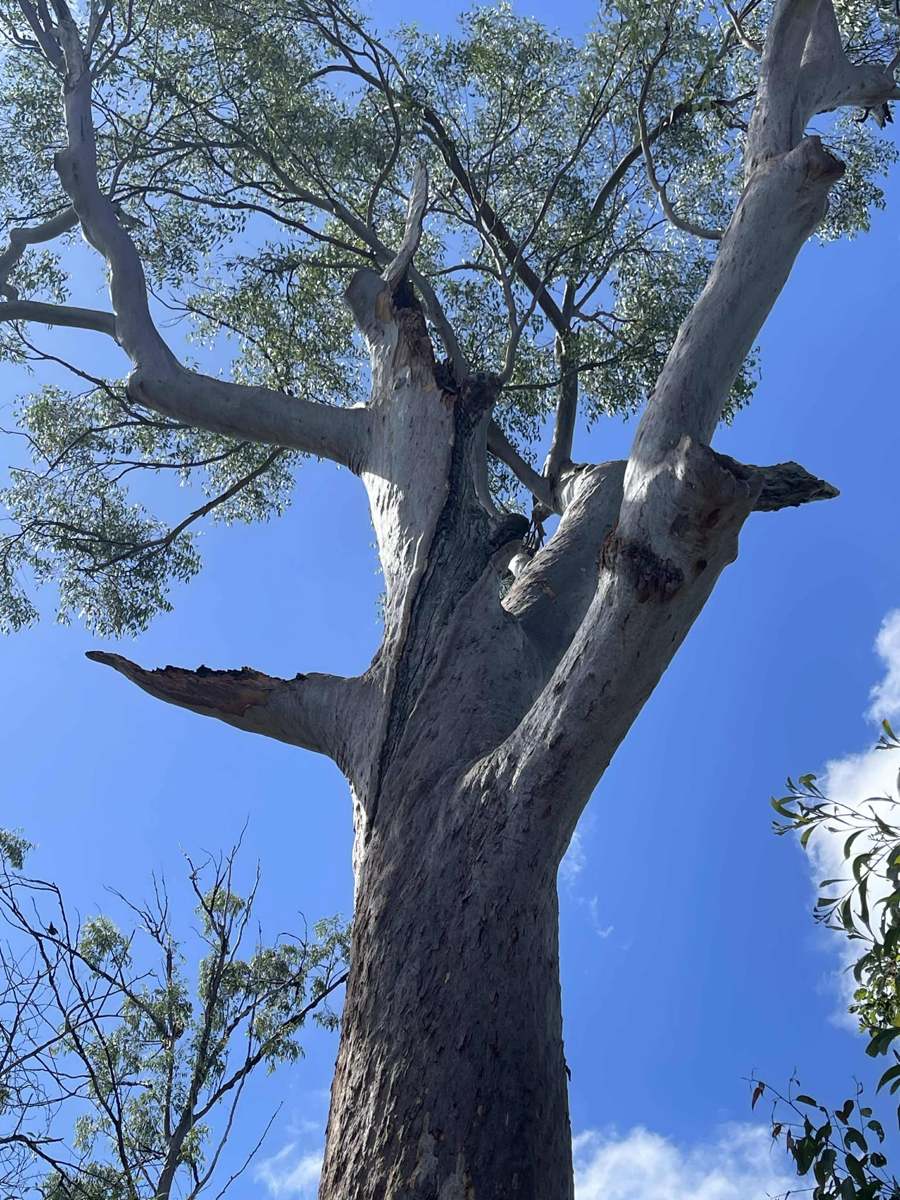
Ipswich’s old gums give plenty of notice if you know where to look. Dead limbs in the top of the crown. Bark lifting or bleeding sap. Fungal brackets at the base, which usually means the root plate or the butt is rotting. A crack where two trunks meet, with bark squeezed in between. Mushrooms in the lawn in a ring around the trunk. Soil heaving on one side after rain, which is the root plate moving. A lean that wasn’t there last year. And the one people miss: the tree looks fine but the ground around it has been dug up for a pool, a driveway or a retaining wall in the last few years. Roots that got cut take time to show up as a dying crown. Any of those, send a photo.
All of it. Reports and assessments are a small part of the week for us, so we fit them in around crews working in Goodna, Redbank Plains, Springfield, Ripley, Booval, Eastern Heights, Brassall, Karalee and Yamanto. If the report says the tree should go, our Ipswich tree removal crew does that; if it says prune, see tree pruning Ipswich. Everything we do in the city is on the Ipswich tree services page.
Call 1300 239 626, or put the address, what’s worrying you and a couple of photos in here. We’ll tell you what kind of assessment you need and what it costs before anyone comes out.
Yes. Our consulting arborists hold the AQF Level 5 Diploma of Arboriculture, which is the qualification councils in South East Queensland expect on a tree report.
A visual assessment can be written up within a few days of the visit. A full report for council or a development application usually takes a week or two depending on the number of trees.
Yes, and plenty of people prefer it, because the arborist who looked at the tree briefs the crew that takes it down. The report is independent in the sense that matters: it says what the tree needs, and if the answer is “leave it alone” that’s what it says. We’ve written plenty of those.
Yes. Tree audits across a whole site, with every tree numbered, assessed and put on a plan with a maintenance schedule. Ask for a consulting arborist quote and tell us how many trees roughly.
Depends on how many trees and what the report is for. A single-tree visual assessment is a modest fixed fee; a development report for a dozen trees is a bigger job. We quote it before the visit so there’s no guessing.
We can assess what we can see from your side and write that up. Going onto their property needs their permission. The report is often what gets the conversation started, and if it doesn’t, it’s what you take to council or QCAT.
