
You have 0 items in your cart
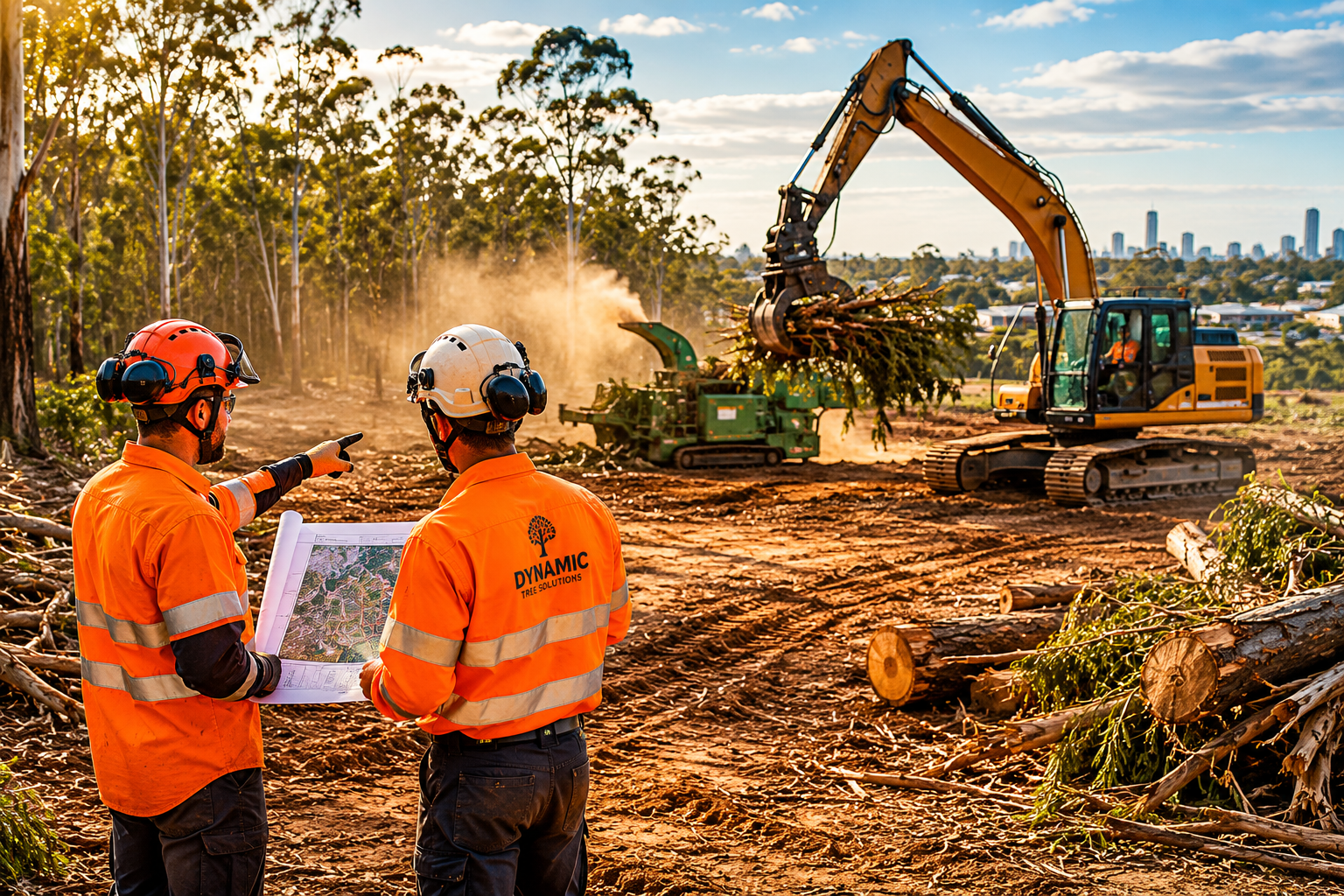
Large-scale civil works across Brisbane and South East Queensland live or die on site preparation. Whether you’re managing a subdivision in Logan, a commercial site at Logan City, infrastructure works through Ipswich, or a development block in the Scenic Rim — what happens during the clearing phase decides how the next eighteen months play out. Most cost blowouts on civil projects don’t come from concrete pours or trade scheduling. They come from land clearing Brisbane contractors who cut corners, miss permits, or leave the site half-prepped for the earthworks crew that follows.
This guide breaks down exactly what developers, project managers and civil contractors need to know about clearing large blocks across Brisbane — the regulatory landscape, the equipment that actually moves dirt and timber fast, the AS 4970-2009 tree protection compliance trap that catches three in ten projects, and the questions you should be asking your commercial tree services contractor before they bring a single mulcher onto site. Dynamic Tree Solutions has run civil-scale clearing across Brisbane, Ipswich, Logan, Moreton Bay and the Scenic Rim for over a decade. Below is the playbook we wish more developers had on day one.
Table of Contents
- Why Civil Works Land Clearing Brisbane Needs More Than a Chainsaw Crew
- Queensland Vegetation Clearing Regulations — What Actually Applies
- Pre-Clearing Site Assessment — The Four Checks That Save Projects
- Equipment That Actually Clears Large Blocks Fast
- Tree Protection Zones — The AS 4970 Trap
- On-Site Biomass Processing vs Haul-Away
- Safety and Compliance — WorkSafe, SWMS, and Tier 1 Documentation
- Hazardous Tree Clearing on Civil Sites
- Council-Specific Considerations Across South East Queensland
- What to Look For in a Civil Works Land Clearing Brisbane Contractor
- Civil Clearing Pricing — Realistic Benchmarks for 2026
Why Civil Works Land Clearing Brisbane Needs More Than a Chainsaw Crew
Residential tree work and civil-scale block clearing are different sports. A house lot might involve three trees and a stump grind. A 12-hectare subdivision block involves vegetation management plans, sediment control, protected tree assessments, root-zone protection for retained specimens, debris stockpiling, biomass disposal, traffic management on adjacent roads, and ongoing compliance reporting to council. Get any one of those wrong and your stop-work notice arrives before you’ve poured the first concrete pad.
A properly executed land clearing Brisbane job for civil works does five things at once: it removes vegetation to the agreed boundary, protects what’s required to remain, processes biomass on-site to minimise haul-away costs, leaves a workable surface for earthworks plant, and produces the paperwork council will ask for. Skip any one of those and the next contractor on site is solving your problem at their hourly rate.
Queensland Vegetation Clearing Regulations — What Actually Applies to Your Site
The legal framework for civil works clearing in Queensland sits across multiple instruments. At state level, the Queensland Vegetation Management Act 1999 governs clearing on freehold and leasehold land, particularly remnant vegetation mapped under the regulated vegetation map. The Queensland Government’s vegetation clearing rules classify what’s protected, what’s exempt, and what triggers a development approval.
At local government level, every council has its own overlay framework. Brisbane City Council enforces vegetation through the Natural Assets Local Law (NALL), with trees over 40cm circumference at one metre off the ground triggering permit assessment. Our Brisbane City Council tree regulations guide covers the NALL thresholds and exemption pathways in detail. Logan, Ipswich, Moreton Bay and Scenic Rim councils each maintain their own vegetation overlays — see the consolidated council tree regulations reference for the boundary maps and permit pathways for each.
For development sites specifically, two further frameworks come into play. AS 4970-2009 Protection of Trees on Development Sites sets out tree protection zone (TPZ) and structural root zone (SRZ) calculations for any retained trees — and gets cited in council DAs as the default benchmark. The Queensland Planning Act 2016 sits above the Act for development approvals where vegetation impact is part of the application. An experienced AQF Level 5 consulting arborist reads all of these into a single arboricultural impact assessment that goes with your DA — that’s the document that turns a clearing intent into a council-approved scope of works.
Pre-Clearing Site Assessment — The Four Checks That Save Projects
Before a single tree comes down on a civil works block, four assessments need to be on file. Skip any of them and you’re gambling with the project program.
- Tree audit and AIA. Every tree above council size threshold is identified, measured, mapped, condition-graded and tagged retain/remove. Our arborist reports follow the AS 4970-2009 methodology so council can sign off without back-and-forth.
- Underground services locate. Dial Before You Dig (1100) plot covering electricity, water, sewer, gas, telco. Forestry mulchers and tracked dozers don’t care about a 32mm water main — until they don’t. Always overlay the DBYD plot onto the vegetation map before mobilisation.
- Vegetation protection overlay check. Pull the council overlay map for the lot — Brisbane’s City Plan 2014, Logan’s planning scheme, or the relevant LGA equivalent — and identify any waterway corridors, biodiversity overlays or significant vegetation overlays that change the clearing scope.
- Erosion and sediment control plan (ESCP). Clearing exposes soil. Council and the EPA require a compliant erosion and sediment control plan in place before, during and after the clearing phase. Sediment fences, stabilised entry/exit, and stockpile management all need to be set up before mulchers fire up.
Equipment That Actually Clears Large Blocks Fast
Forestry Mulchers, Excavators, Skid Steers and Stump Grinders for Land Clearing Brisbane
Forestry Mulchers, Excavators, Skid Steers and Stump Grinders for Land Clearing Brisbane
The right plant turns a three-week job into a five-day job. The wrong plant or undersized equipment makes simple work expensive. For civil-scale land clearing Brisbane, four equipment categories carry the load:
- Forestry mulchers — Tracked carriers with rotary drum mulching heads. Convert standing vegetation up to 350mm diameter into mulch on-site in a single pass. No truck movements. No tip fees. The mulch becomes erosion-control groundcover for the earthworks phase.
- Excavator with mulching head or grapple saw — For trees above mulcher range, a 20-tonne excavator with a Femac or Bandit mulching head, or a grapple saw attachment, handles the heavy lift. Critical for working near boundaries and underground services where precision matters.
- Skid steer with mulching, slashing or grapple attachments — For the fine work between large trees, vegetation slashing, and stockpile management. The all-rounder on a clearing site.
- Stump grinders — For retained tree zones and finished surface preparation. Our stump grinding Brisbane service runs tracked grinders rated for civil-site work where ride-on machinery is too small.
Matching equipment to vegetation density, tree size mix, terrain and access is the difference between a productive day and a stalled job. Get a contractor on-site before quoting — drone overhead photography is fine for desktop scoping but doesn’t replace boots on the block.
Tree Protection Zones — The AS 4970 Trap
If your DA requires retention of any trees on the site — even just one — AS 4970-2009 applies. The standard prescribes a Tree Protection Zone (TPZ) calculated as 12 × diameter at breast height (DBH), capped at 15m. Inside the TPZ, no soil compaction, no root disturbance, no machinery movement, no stockpiles, no fuel storage. The Structural Root Zone (SRZ) within the TPZ is a no-touch zone entirely.
This catches more civil sites than any other compliance item. The clearing crew clears to plan, the earthworks crew arrives, ground gets compacted around a retained tree, the tree dies inside 18 months, and council comes back with a non-compliance notice and a make-good order. Plan for AS 4970 from day one: fence the TPZs in temporary chain-mesh, paint-mark the boundaries, brief every contractor entering the site, and document the protection in your monthly compliance reports.
On-Site Biomass Processing vs Haul-Away
Civil-scale clearing generates enormous biomass. A 5-hectare block of mature eucalypt can produce 800–1,500m³ of green waste. The two disposal pathways are on-site mulching or haul-away to a green waste facility.
On-site forestry mulching wins on cost in almost every case. The mulch stays on the block as erosion-control groundcover, suppresses weed germination during the construction phase, and breaks down into soil organic matter over 12–24 months. Haul-away involves truck movements, tip fees of $80–$150 per tonne depending on the facility, and increased traffic management on adjacent roads. For commercial developers running tight margins, on-site processing is almost always the right call unless the receiving soils need to be free of woody debris for engineering reasons.
Where haul-away is necessary, our trucks run direct to licensed green waste facilities across Brisbane and SEQ, with weighbridge dockets supplied for project records.
Safety and Compliance — WorkSafe, SWMS, and Tier 1 Documentation
Civil sites need civil-grade safety documentation. WorkSafe Queensland regulates high-risk construction work, which captures most civil clearing activities. Your clearing contractor needs to deliver:
- Site-specific Safe Work Method Statements (SWMS) for every high-risk activity — chainsaw operations, mulching, working near power lines, working at heights, traffic management
- Plant pre-start inspection records
- Toolbox talk and induction records for every crew member
- $20M public liability insurance and current workers compensation certificates
- Compliance with Arboriculture Australia industry safe work practices
Dynamic Tree Solutions runs Tier 1 safety and compliance systems across every civil project. We carry $20M public liability cover, all crew are AQF Level 3 minimum (Level 5 for consulting), and we deliver project-specific safety documentation as part of the contract — not as an afterthought when the principal contractor asks.
Hazardous Tree Clearing on Civil Sites
Not every tree on a development block can be felled by a forestry mulcher. Large eucalypts overhanging structures, dead trees with structural compromise, leaning trees in tight access, trees through power line corridors — these need a different approach. Our hazardous tree clearing team uses sectional dismantling, crane-assisted removal where required, and rigging techniques to bring difficult trees down safely. The same technical capability that handles a hazardous gum over a Brisbane house extends to industrial-scale work on civil sites where collateral damage to retained infrastructure isn’t an option.
Council-Specific Considerations Across South East Queensland
Each council brings its own quirks to civil clearing:
- Brisbane City Council — NALL applies; significant tree register triggers higher-tier assessment; biodiversity overlays in suburbs like Karawatha, The Gap and Mt Coot-tha require additional clearing controls.
- Logan City Council — Strong focus on koala habitat overlays; works in southern Logan often trigger state Koala Conservation Plan considerations.
- Ipswich City Council — Rapid growth corridor; clearing in Springfield, Ripley and Yamanto routinely involves remnant vegetation assessment.
- Moreton Bay Regional Council — Waterway buffer overlays applied aggressively; sites near Pine River, Caboolture River or coastal estuaries need additional ESCP detail.
- Scenic Rim Regional Council — Rural and rural-residential zones often have vegetation management policies tied to bushfire risk overlays.
What to Look For in a Civil Works Land Clearing Brisbane Contractor
Before signing the contract, ask the questions that filter the professionals from the chainsaw cowboys:
- Do you carry $20M+ public liability and workers compensation? (Show certificates.)
- Are your consulting arborists AQF Level 5 qualified for the AIA?
- What plant do you bring to a 10-hectare clearing — and is it owned or hired? (Owned operators run faster, more reliably.)
- Can you supply project-specific SWMS, ESCP advice, and compliance reporting?
- Do you have direct experience with this council’s permit pathway?
- What’s the on-site biomass plan — mulch in place or haul-away?
- Who is the project manager I’ll deal with daily?
Civil Clearing Pricing — Realistic Benchmarks for
Land Clearing Brisbane Cost per Hectare — Light, Moderate and Heavy Clearing
Land Clearing Brisbane Cost per Hectare — Light, Moderate and Heavy Clearing
Civil clearing pricing in Brisbane and SEQ depends on vegetation density, tree size mix, terrain, access, debris disposal pathway and project complexity. Realistic benchmarks for 2026:
- Light vegetation forestry mulching — $1,800 to $3,200 per hectare
- Moderate density clearing (mixed vegetation, some heavy timber) — $4,500 to $8,500 per hectare
- Heavy clearing (mature eucalypt stands, dense bushland) — $8,000 to $15,000+ per hectare
- Hazardous tree removal on civil sites — Quoted per tree, typically $1,500 to $8,000 each depending on access and complexity
- Arboricultural Impact Assessment — From $1,800 for residential infill, $5,000+ for larger commercial DAs
- Post-clearing stump removal — $150 to $500 per stump depending on size
Always get a site-specific quote. Hectare rates vary widely with terrain, tree density and disposal pathway.
Talk to a Civil Works Clearing Specialist
Dynamic Tree Solutions runs civil-scale land clearing across Brisbane and South East Queensland. AQF Level 5 consulting arborists, $20M public liability, Tier 1 safety systems, owned plant fleet, and direct experience with every SEQ council’s development pathway. We provide free written quotes on civil clearing scopes — typically turned around inside 48 hours of a site visit.
Call 1300 239 626 or use the online quote form to book a site assessment. Need an arboricultural impact assessment for your DA? Our consulting arborists turn AIAs around inside two weeks of site visit. Need fast tree removal across Brisbane? We mobilise within 48 hours for civil works programs.
