
You have 0 items in your cart
An arborist report for an insurance claim is a short, dated document from a qualified arborist that says what the tree was, how it failed, why it failed, and what should happen to what is left. Insurers, assessors and builders ask for one when the cause of the damage is in question, when the tree belongs to a neighbour or the council, or when a claim has been knocked back. The make-safe comes first; the report comes second, and it is written from the evidence the make-safe crew saves.
Nine days on from the 11 November supercell, the phone has moved on from “there’s a tree on my roof” to “my assessor wants a report”. Same job, different paperwork, and the calls are coming from the suburbs Logan City Council listed as hardest hit, Park Ridge, Logan Village and Jimboomba among them. So here is what an arborist report for an insurance claim actually needs to contain, who can write one, and how to avoid paying for a report you did not need.
Do I need an arborist report for an insurance claim?
Usually not for a straightforward one. If a healthy tree came down in a storm that the Bureau called a supercell and it landed on your own roof, most insurers want photos, the make-safe invoice and your claim number. The Insurance Council of Australia’s advice after any declared event is to make the property safe, keep the receipts and lodge promptly; nobody at the ICA is asking you for a tree report on day one. The ICA has declared the Logan storms Significant Event SE265, which tells you the insurers already know what hit the area.
You need a report when something about the claim is in dispute. The five situations we see most:
- Cause of failure is questioned. The assessor thinks the tree was already dead, rotten or badly pruned, and the policy has a maintenance or “wear and tear” exclusion. The report settles whether the failure was the storm or the tree.
- It was the neighbour’s tree. Your insurer may want to recover costs from their insurer, and that argument runs on evidence about the tree’s condition before it fell.
- It was a council tree. A street tree or a park gum like the one we cleared off a footpath beside a block of units this week. Council has its own process, and your insurer will want an independent opinion on it.
- The claim was declined or part-declined. A report is the main thing you can put in front of the internal dispute team, and later the Australian Financial Complaints Authority, that they did not have the first time.
- Something is still standing. Half a tree, a cracked neighbour, three more gums on the same soaked bank. The insurer wants to know whether paying for removal now costs less than the next claim.
If none of those apply, spend the money on the make-safe and the fence, not on us writing things down.
What does an arborist report for insurance actually contain?
A good one is five to ten pages and reads like a mechanic’s report on a crash, not an essay. The assessor is looking for specific things, so the report is built around them:
| Section | What goes in it | Why the insurer cares |
|---|---|---|
| Tree identification | Species, height, trunk diameter at 1.4 m, canopy spread, location on a site sketch, who owns it | Confirms which tree, whose tree, and that it existed as described |
| Condition before failure | Decay, cavities, fungal brackets, included bark, previous lopping cuts, root damage from works, lean, dieback | This is the “was it already a hazard” question |
| Failure mode | Root plate failure, stem snap, branch tear-out, or a hanger that dropped later; where on the tree it let go | Separates a wind event from a defect |
| Cause and contributing factors | Recorded wind and rain, saturated soil, exposure, soil type, the condition findings above | Ties the failure to the insured event with dated weather data |
| Photographs | Annotated: the failure face, the root plate, decay columns, the cut log ends, the damage | Assessors believe photos before they believe prose |
| Residual risk | What is still standing and its likelihood of failure, using a recognised risk method | Decides whether removal of the remainder is covered or recommended |
| Recommendation | Remove, reduce, retain and monitor, or refer to council; timeframe; who should do it | Gives the builder a scope line they can price |
| Author details | Name, AQF Level 5 qualification, insurances, date of inspection, date of report | Without this the report carries no weight |
The weather data matters more than people think. On 11 November Logan City Council reported gusts up to 125 km/h, the Bureau recorded 59 mm in 30 minutes at Logan Village, and the SES logged around 300 calls in Logan that night with trees in roughly a third of them. A report that quotes those figures with their sources, against a tree that came out root plate and all in soaked ground, is very hard to argue with. A report that says “it was windy” is not.
Who can write an arborist report that an insurer will accept?
An arborist with an AQF Level 5 qualification, the Diploma of Arboriculture. That is the level councils in South East Queensland ask for on development applications and it is the level assessors expect on a claim. A Level 3 climber is qualified to take the tree down; they are not qualified to write the opinion on why it fell, and a report from one gets picked apart the moment the other side has a Level 5 read it.
It also helps if the person writing it was on the job or inspected before the stump was ground. Our consulting work runs through arborist reports in Brisbane, Logan and Ipswich, and the reports that land best are the ones where the make-safe crew knew a report was coming and left the evidence in place: the root plate uncut, the failure face of the stem whole, a tape on the trunk in the photo. Tell the crew on day one if an assessor is involved. The make-safe tree removal page explains how we run that handover with insurance builders.
Make-safe first, report second: why the order matters
Nobody should delay getting a tree off a roof to wait for a report. Water coming in doubles the claim every night it rains. The order is: ring the insurer and get a claim number, get the tree made safe, then if a report is needed it is written from the photos and the retained timber. Our Logan storm damage and insurance guide covers the night-of steps, and what insurance usually covers after a storm covers the policy side.
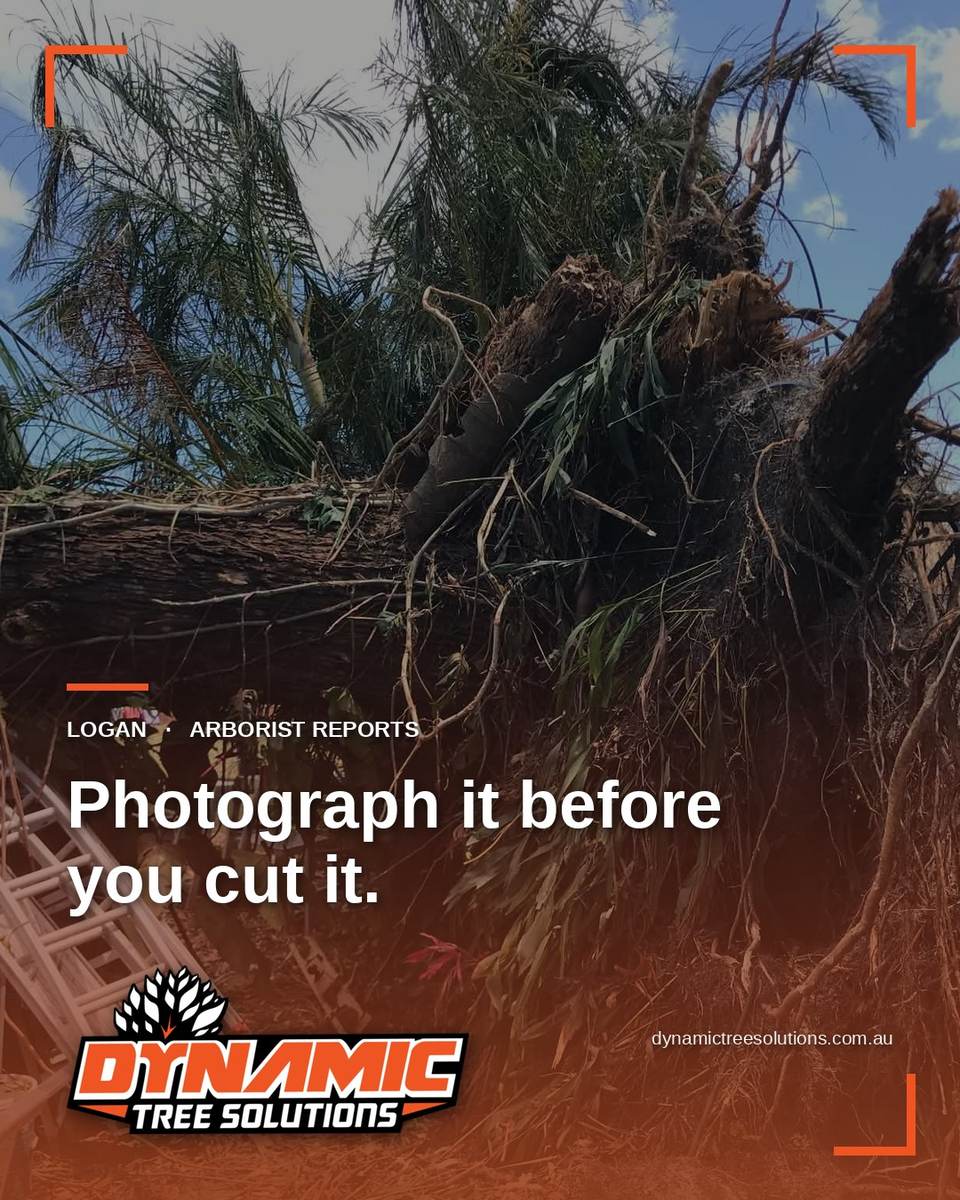
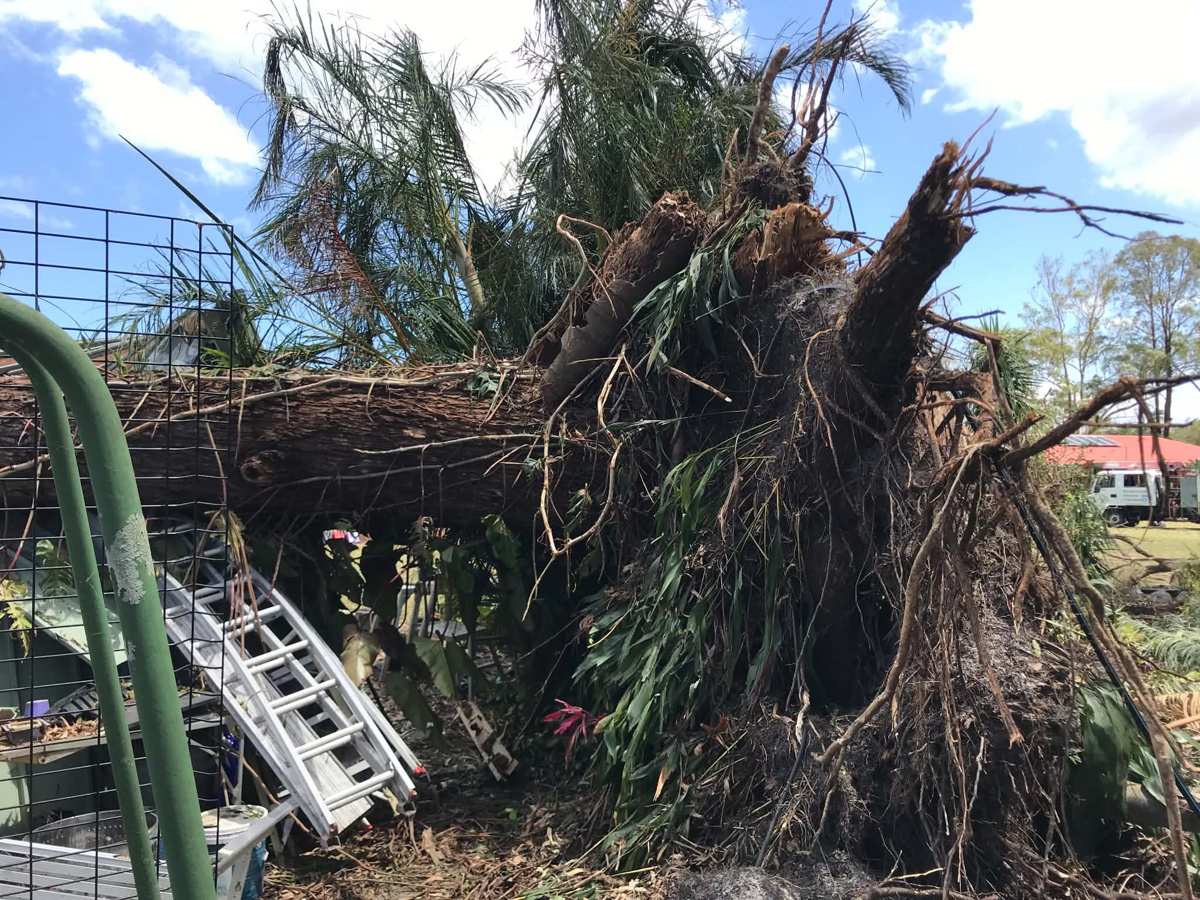
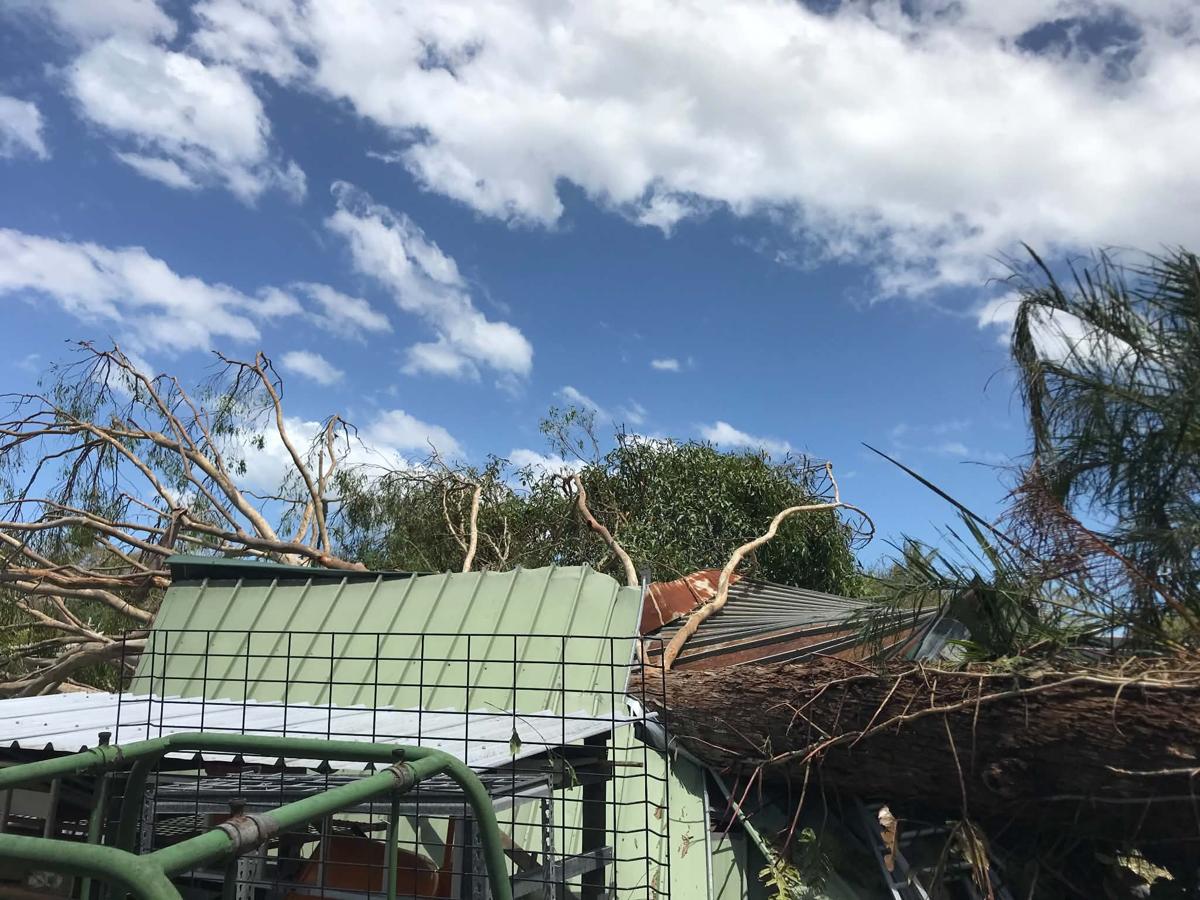
One thing from a job this week, because it is the whole point. A big gum on a Logan block went over root plate and all, the plate standing up on its edge like a dinner plate, trunk across the shed and a steel stock cage, the owner’s ladder still leaning on it. Look at the photo above. That is a mass of sound roots that let go of mud, not a rotten tree that finally gave up, and the photos taken before the first cut are what say so. If a crew cuts that into rounds and chips it on day one, there is nothing left to prove it was a storm failure, and “gums have a history of failing” becomes the only story in the file.
Who pays for the arborist report?
Whoever orders it, as a rule. If your insurer wants a report to decide the claim, they commission and pay for their own assessor or arborist. If you commission one to challenge a decision, you pay, and you can ask for it to be included in the claim if the report changes the outcome. On a neighbour’s-tree claim, the report is normally paid by the side using it. Keep the invoice either way; it belongs in the claim file with everything else.
What drives the fee is time: a single failed tree with the evidence intact is a couple of hours on site and a few more at the desk. A disputed claim with six trees across a soaked bank, a neighbour’s fence line and a council verge is a day’s work and a longer document. We quote it before we start.
What about a neighbour’s tree or a council tree?
In Queensland the Neighbourhood Disputes (Dividing Fences and Trees) Act 2011 makes the “tree-keeper”, the person whose land the trunk stands on, responsible for their tree, and tree disputes between neighbours end up at the Queensland Civil and Administrative Tribunal. The Queensland Government’s guide to tree and fence disputes and QCAT’s tree disputes process set out how that runs. An arborist report is the central document in almost every one of those matters, because the question is always whether the tree-keeper knew, or should have known, the tree was a risk.
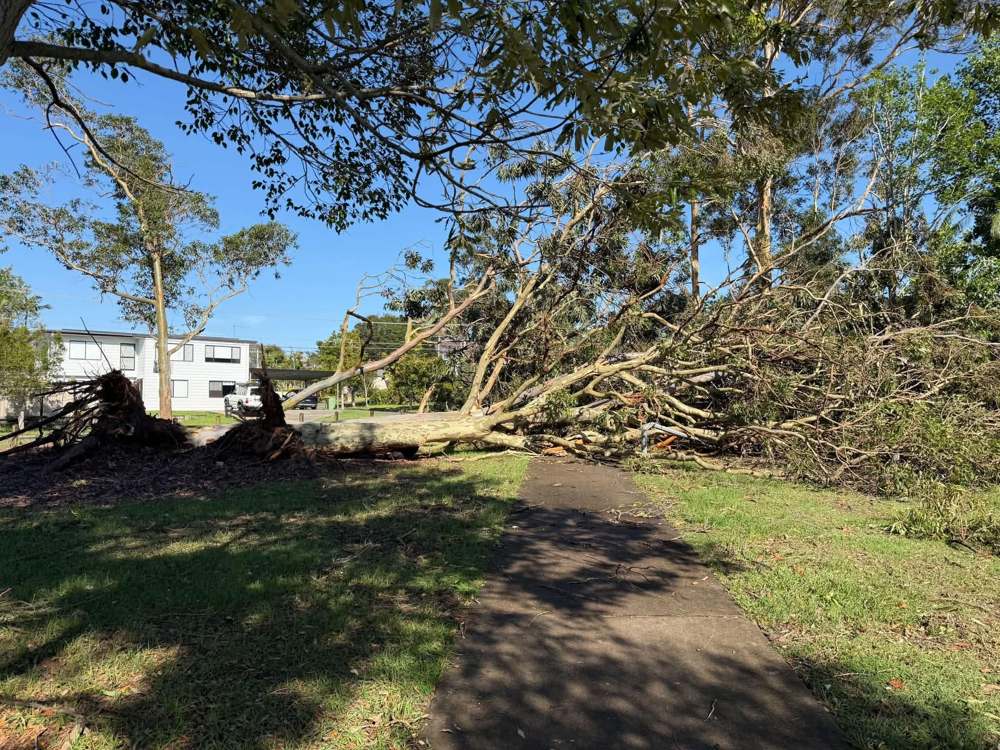
Council trees are different. Street trees and park trees on Logan City Council land are council’s to assess and remove, and you report them to council rather than hiring your own crew. Your insurer deals with the damage to your property; whether they chase council afterwards is their call, and that is where a report on the tree’s pre-failure condition becomes useful to them. Do not touch a council tree yourself, and do not touch anything within 3 metres of a powerline; that is Energex and authorised contractors only.
How long does an arborist report take?
Inspection within a day or two of the call in a storm week, report inside a week of the inspection for a single-tree claim. If a crew has already made the site safe and photographed the evidence, it is faster, because half the inspection is already done. A report for a QCAT matter or a declined-claim dispute takes longer, because the document has to stand up to someone whose job is to pull it apart. Ask for the turnaround when you book it and ask what the arborist needs from you: the claim number, the assessor’s name, any photos you took on the night, and the dates of any previous work on the tree.
What should I do right now if the assessor has asked for one?
Three things. Keep every photo you have of the tree before and after, including old ones from the back of the phone showing the tree in leaf. Tell the tree crew not to grind the stump or cut the root plate until an arborist has seen it. Then book the inspection and give the arborist the assessor’s contact so the two of them can talk directly; the report answers the assessor’s questions, not ours.
If you are in Logan Village, Jimboomba, Park Ridge or anywhere across Logan and Brisbane’s southside and an insurer, assessor or builder has asked for a report, ring the office on 1300 239 626 or send the details through the quote form with your claim number and we will tell you straight whether you need one.
Frequently asked questions
Do I need an arborist report for an insurance claim?
Not for a straightforward storm claim where a healthy tree hit your own property; photos, the make-safe invoice and your claim number usually do it. You need one when the cause of failure is questioned, the tree belonged to a neighbour or the council, the claim was declined, or something is still standing and the insurer wants to know the risk.
Who pays for an arborist report?
Whoever commissions it. If the insurer wants one to decide the claim, they arrange and pay for their own. If you order one to challenge a decision, you pay, and you can ask for it to be included in the claim if it changes the outcome. Keep the invoice with the rest of the claim file.
Can I get an arborist report for a neighbour's tree that damaged my property?
Yes, and it is often the central document. In Queensland the tree-keeper, the person whose land the trunk stands on, is responsible for their tree under the Neighbourhood Disputes (Dividing Fences and Trees) Act 2011, and disputes go to QCAT. The report looks at whether the tree's condition before it fell was something the owner should have acted on.
How long does an arborist report take?
Inspection within a day or two in a storm week, and the report inside about a week for a single failed tree. It is faster when the make-safe crew photographed the evidence and left the root plate and failure face uncut. Reports for declined claims or QCAT matters take longer because they have to stand up to challenge.
What qualification does the arborist need to write an insurance report?
AQF Level 5, the Diploma of Arboriculture. That is the level South East Queensland councils ask for on applications and the level assessors expect on a claim. A Level 3 arborist can remove the tree but a report from one carries little weight once it is challenged.
Do I need an arborist report for a council tree that fell on my property?
Report the tree to council first; street and park trees are council's to assess and remove. Your insurer handles the damage to your property, and if they want to pursue council afterwards, a report on the tree's condition before it failed is what they will use. Never touch a council tree yourself or anything within 3 metres of a powerline.
