
You have 0 items in your cart
Tree fell on my house, what do I do? Get everyone out of the rooms under it, stay away from any powerlines it has pulled down, and ring 000 if anyone is hurt or a line is on the house. Then photograph everything, call your insurer to open a claim, and get an arborist to make it safe. Do not let anyone climb on the roof or start cutting until a professional has looked at how the tree is sitting.
That is the one-minute version. Here is the longer one, from a crew that spends every storm season from October to March pulling gums off roofs across Brisbane, Logan and Ipswich.
Quick note before we start: we are arborists. We are not your insurer, your builder or your lawyer. What follows is what we have learned on the job, not advice about your policy.
Tree fell on my house: what do I do in the first ten minutes?
Slow down. Nearly every bad decision we see after a storm happens in the first ten minutes, when someone is running on adrenaline and wants the tree gone right now.
1. Get people out from under it. A tree that has come through a ceiling is being held up by the trusses, the gutter, a fence, or sometimes nothing much at all. Move everyone to a part of the house the tree is not touching, or outside, upwind of the tree.
2. Look for powerlines before you look at anything else. If the tree has brought down the service line that runs from the street to your house, or is leaning on it, treat the whole area as live. Energex says to stay at least 10 metres away from a tree touching powerlines, warn everyone else, and report it on 13 19 62. Life-threatening situations are a 000 call. The Energex trees and powerlines page covers the detail.
3. Turn off what you can reach safely. If the tree has opened up the roof and water is coming in near the switchboard, and the board is dry and away from the tree, switch the mains off. If you are not sure, leave it and tell the electrician or Energex.
4. Ring 000 if anyone is hurt.
5. Ring the SES on 132 500 if rain is coming in. The State Emergency Service tarps roofs and clears what they can during a storm event. They do not remove big trees from houses, but they will stop your ceiling turning into a swimming pool while you sort the rest. Their site is ses.qld.gov.au.
Should I try to cut the tree off the roof myself?
No. We will say that plainly because every storm season someone in the south side does it and ends up in hospital.
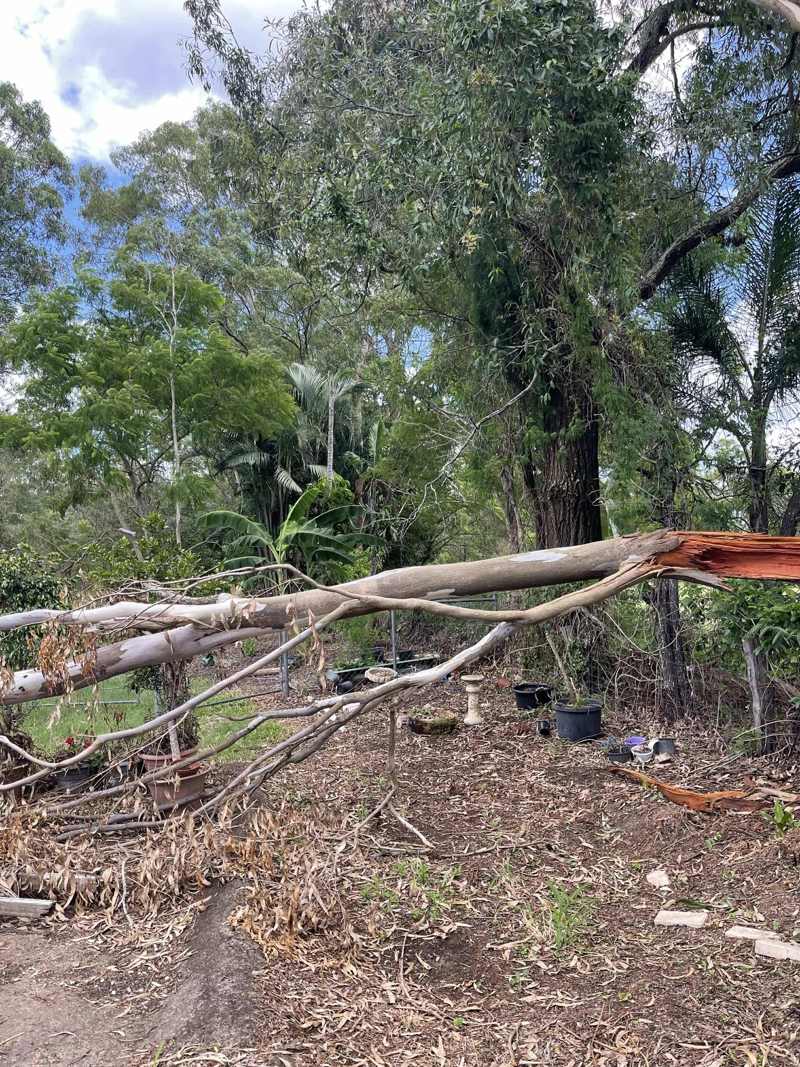
A tree on a house is loaded. The trunk is bent, limbs are pinned, and there is weight sitting on bits of structure that were never designed to hold it. Cut the wrong limb and the whole thing rolls, springs or drops. We have seen a snapped gum limb lying quiet across a backyard look completely harmless, right up until the bloke with the chainsaw cut the one branch holding it off the ground.
Roof work adds a second problem. Wet tiles, loose sheets, and a tree that has already shown it can move. That is a fall waiting to happen, and it is why our crews work from a harness, a crane or an elevated work platform, never off the roof itself.
Leave the chainsaw in the shed. Take photos instead.
What photos and records do I need for the insurance claim?
Insurers pay faster when the story is clear. Before anyone touches the tree, get:
- Wide shots from every side showing the tree and the house together.
- Close-ups of the damage: roof, gutters, walls, fence, carport, anything it hit.
- The base of the tree, including the stump or root plate, so it is obvious where it came from.
- Photos inside the house of ceilings, water damage and wet floors.
- A note of the date and time, and roughly when the storm hit.
Then ring the insurer and open the claim before you book the removal. Most policies let you make the place safe straight away, but they want to know about it first. We went through what is and is not usually covered in our post on whether insurance covers tree removal after a storm, so we will not repeat it all here. The short of it: if the tree damaged something the policy insures, removal is usually part of the repair. If it landed on the lawn and hit nothing, it is usually your cost.
Make safe or full removal: which one do I actually need?
| Stage | What happens | When |
|---|---|---|
| Make safe | We take the weight off the house, cut the tree back so nothing else can drop, and tarp or clear so the builder can get in. The stump and most of the trunk often stay. | Same day or next day, often while the storm is still passing through. |
| Full removal | Everything goes: trunk, limbs, debris, and the stump if you want it ground out. Site left clean. | Once the insurer has given the nod and the builder knows what they are working around. |
| Assessment of the trees left standing | An AQF Level 5 arborist checks the other trees near the house for cracks, lean and root-plate movement, and writes it up. | Within the week, before the next storm cell. |
Most insurers will pay for make-safe without much argument because it stops the damage getting worse. Full removal and stump grinding are where the policy wording matters, so ask before you commit. Our emergency tree removal crews quote the two stages separately so you can hand the insurer something they understand.
Who do I ring, and in what order?
Here is the order we would use at our own place:
- 000 if anyone is hurt or there are live powerlines on the house.
- Energex on 13 19 62 for a fallen or damaged powerline that is not an immediate threat to life.
- SES on 132 500 for a tarp if water is coming in.
- Your insurer to open the claim and get a claim number.
- An arborist to make it safe. Give them the claim number; it saves a phone call later.
- A builder or roofer once the tree is off and they can see what they are dealing with.
Our office number is 1300 239 626 and it is answered through storm season. If the tree is on the house we will treat it as urgent, but be honest with us about what it has hit: a gum through a bedroom gets a crew before a branch on a shed, and everyone understands that.
What if it was the neighbour’s tree that fell on my house?
This is the question that starts arguments over the fence, so here is how it generally goes. In a storm, a healthy tree that fails is treated as an act of nature. Your insurer deals with the damage to your house, and the neighbour’s insurer deals with theirs. Nobody is automatically at fault just because the tree grew on their side.
Where it changes is if the tree was obviously dead, hollow or hazardous and the owner had been told and did nothing. Then there can be a liability question, and that is a lawyer or insurer conversation, not an arborist one. What we can do is write an arborist report on the condition of the tree, which is the piece of paper both insurers will want. Our arborist reports page explains what goes into one.
Whoever owns the tree, the practical advice is the same. Make it safe first, argue about it second. Trees do not care about boundaries.
What happens if a tree falls on my house but does not come through?
This is more common than the dramatic version. A limb drops on the roof, dents some sheets, cracks a few tiles and stays up there. The house looks fine from the street.
Still treat it as urgent. A limb sitting on a roof moves every time the wind picks up, and it grinds through the roofing a little more each time. Water finds the cracked tiles, the ceiling sags a week later, and now it is a bigger claim. Get it off the roof the same week, and have someone look at the tree it came from, because a gum that has dropped one limb in a storm has usually got another one ready to go. That is the kind of job our dangerous tree removal team sees most weeks in October and November.
Does it matter which council I am in?
A little, mostly for what happens after. Making a storm-damaged tree safe is an emergency, and the councils across south-east Queensland all allow you to deal with an immediate hazard. Brisbane City Council asks for photos and an arborist report within 10 business days when a protected tree is removed as an immediate hazard. Logan and Ipswich have their own vegetation rules for anything beyond the emergency work, and our council tree regulations page runs through them in plain words.
Across Redlands, Logan and Moreton Bay the storm cells land differently, but the pattern is the same. In Capalaba it is big gums and the odd old camphor laurel over established homes. Around Tanah Merah it is bush blocks with eucalypts right up against the house. Up at Caboolture we see a lot of poincianas and cocos palms that shed limbs and fronds onto carports when the first October storm rolls through. Photograph it, call it in, and let someone with a harness deal with the rest.
How do I stop it happening again?
The honest answer is you cannot stop every storm, but you can stop most of the surprises. Once the tree is off the house, have the rest of the yard looked at. We are checking for dead wood over the roof, limbs with cracks or included bark, trees leaning towards the house since the storm, and soil heaving around the base, which means the roots have moved. Dead-wooding and weight reduction before the next cell is a small job. A second tree on the roof is not.
If you have a tree on the house right now, call 1300 239 626. If you would rather send photos first, use our quote form and the office will ring you back.
Frequently asked questions
If a tree falls on my house, what do I do first?
Get everyone out of the rooms under the tree, stay well clear of any powerlines it has touched, and ring 000 if anyone is hurt or a line is down on the house. Then take photos from every side, call your insurer to open a claim, and book an arborist to make the tree safe. Do not climb on the roof or start cutting.
What to do if a tree falls on your house during a storm at night?
Move to a part of the house the tree is not touching, or outside, and wait for daylight unless water is pouring in or there is a powerline involved. Ring the SES on 132 500 for a tarp and 000 for anything life-threatening. Emergency arborist crews work through the night for genuine danger, but most make-safe work is done more safely at first light.
Neighbour's tree fell on my house, what do I do?
Make it safe first and argue about ownership later. In a storm a healthy tree that fails is generally treated as an act of nature: your insurer handles your house, theirs handles their side. If the tree was known to be dead or dangerous, there can be a liability question, and an arborist report on the tree's condition is what both insurers will ask for.
Tree fell on house, what does insurance cover?
Usually the damage to the building and the cost of getting the tree off it, because that is part of the repair. Stump grinding, trees that fell and hit nothing, and tidying the rest of the yard are often excluded. Read your PDS and ring the insurer before booking a full removal; make-safe work is normally fine to do straight away.
What would happen if a tree fell on my house and I cut it off myself?
You would be working on a loaded, moving tree from a wet, damaged roof, which is how people end up in hospital every storm season. Cutting the wrong limb can make the trunk roll or drop further into the house. It can also complicate the insurance claim. Photograph it and leave the cutting to an arborist with a harness, crane or EWP.
Do I need council approval to remove a tree that fell on my house?
Not for the emergency make-safe work. Councils across south-east Queensland let you deal with an immediate hazard. Brisbane City Council asks for photos and an arborist report within 10 business days if a protected tree was removed as a hazard. Anything beyond the emergency, such as taking out other trees nearby, follows the normal rules for your council.
