
You have 0 items in your cart
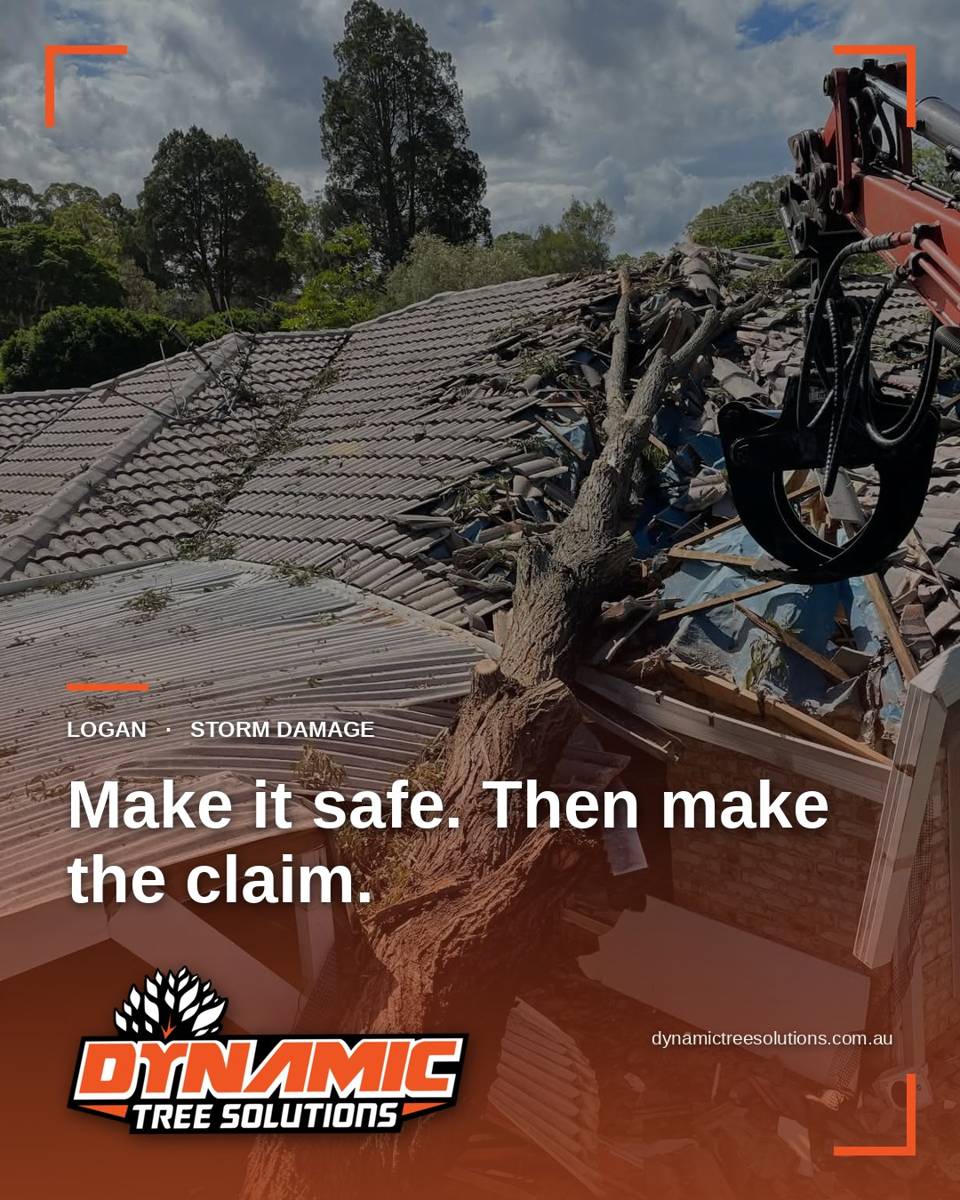
If Wednesday’s supercell put a tree on your house, shed, fence or car anywhere in Logan, do three things in this order: keep everyone away from fallen powerlines and ring Energex on 13 19 62, ring your insurer and lodge the claim today, then get a qualified arborist to make the tree safe and photograph everything before it’s touched. Dynamic Tree Solutions crews have been on storm damage tree removal in Logan since the storm went through, and this is what we’ve learned about getting people’s homes safe and their claims moving.
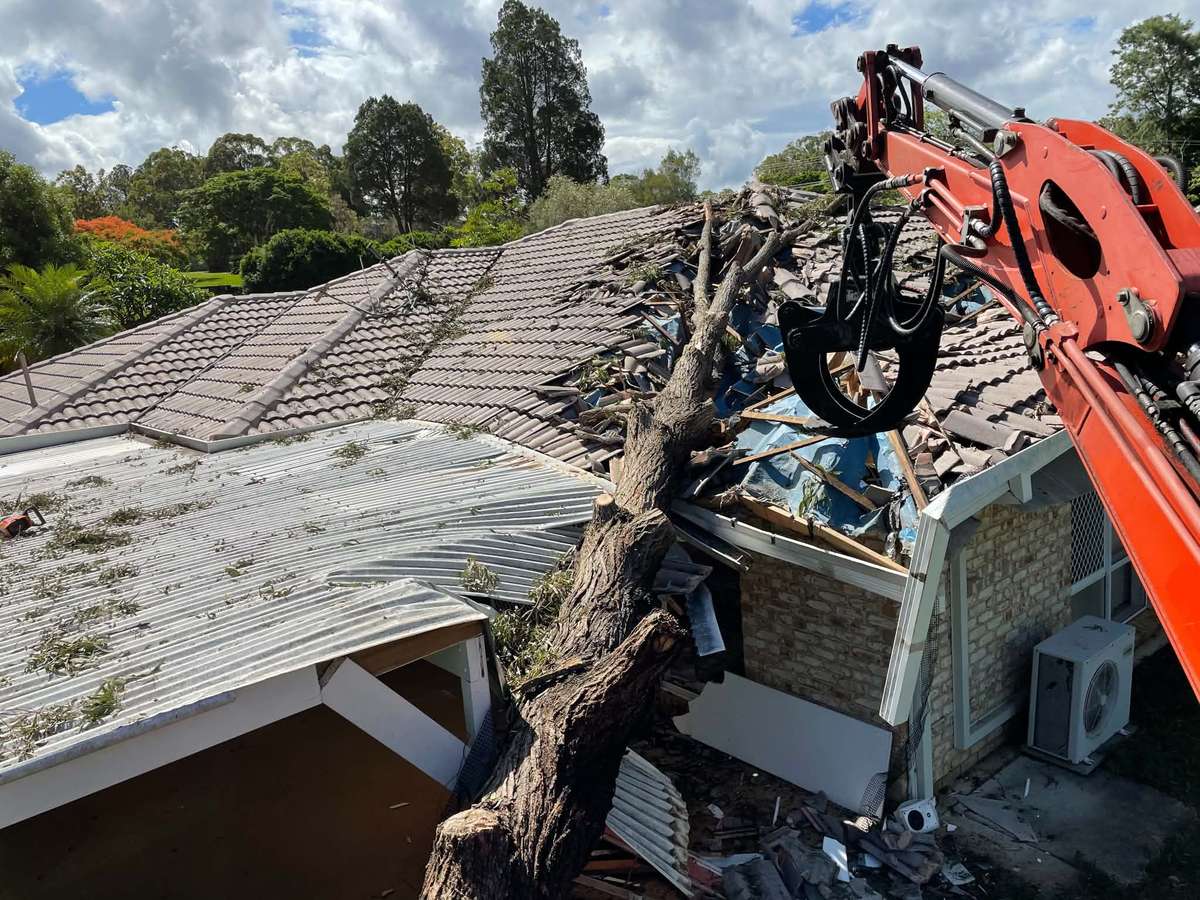
I’ve been doing storm work around Brisbane’s southside for a long time and Wednesday was a bad one. Whole gums out of the ground, roofs peeled back, trunks through ceilings, and in a few streets the powerlines were down on top of the trees that brought them down. The crew in the photo below spent the day lifting a tree off a house with the excavator grab, one piece at a time, so the builder could get a tarp on before the next cell came through.
What actually hit Logan on Wednesday 11 November?
The Bureau of Meteorology called it a spring supercell thunderstorm. It crossed the border ranges late Wednesday afternoon, ran straight over Logan and on into Moreton Bay. Logan City Council reported wind gusts up to 125 km/h, which the Mayor compared to a category 1 cyclone; the Bureau’s station at Brisbane Airport logged 96 km/h and the forecaster said the storm “missed the official wind stations”, so the real number over Logan was likely higher. Logan Village copped 59 mm of rain in half an hour, Wishart almost 80 mm, and 2 cm hail was reported at Canungra.
What that did, according to ABC News and Energex:
- More than 81,000 households lost power across South East Queensland on Wednesday night, almost 60,000 of them in Logan.
- More than 400 powerlines came down, 85 per cent of them in Logan and the Scenic Rim. Energex crews reported concrete poles smashed and said some sections of the network have to be rebuilt.
- Council counted 14 homes left uninhabitable. A roof came off at Regents Park. A tree came down on a car on Chambers Flat Road at Munruben.
- The SES logged around 315 requests for help across Logan: roughly 46 per cent structural damage, 30 per cent fallen trees. Hardest hit were Crestmead, Logan Village, Marsden, Chambers Flat, Jimboomba and Waterford, with jobs in Regents Park, Heritage Park, Yarrabilba, North Maclean and Kingston.
- Around 20 Logan schools were closed on Thursday, and phone towers were out in Marsden, Crestmead and Waterford West.
The Bureau has said the storm risk runs through the weekend and possibly into Monday. So this isn’t over, and anything still hanging in a tree over your house needs dealing with before the next one.
Tree on the house: what do I do first?
Same order every time, storm or no storm.
- People first. Anyone hurt or trapped, ring 000.
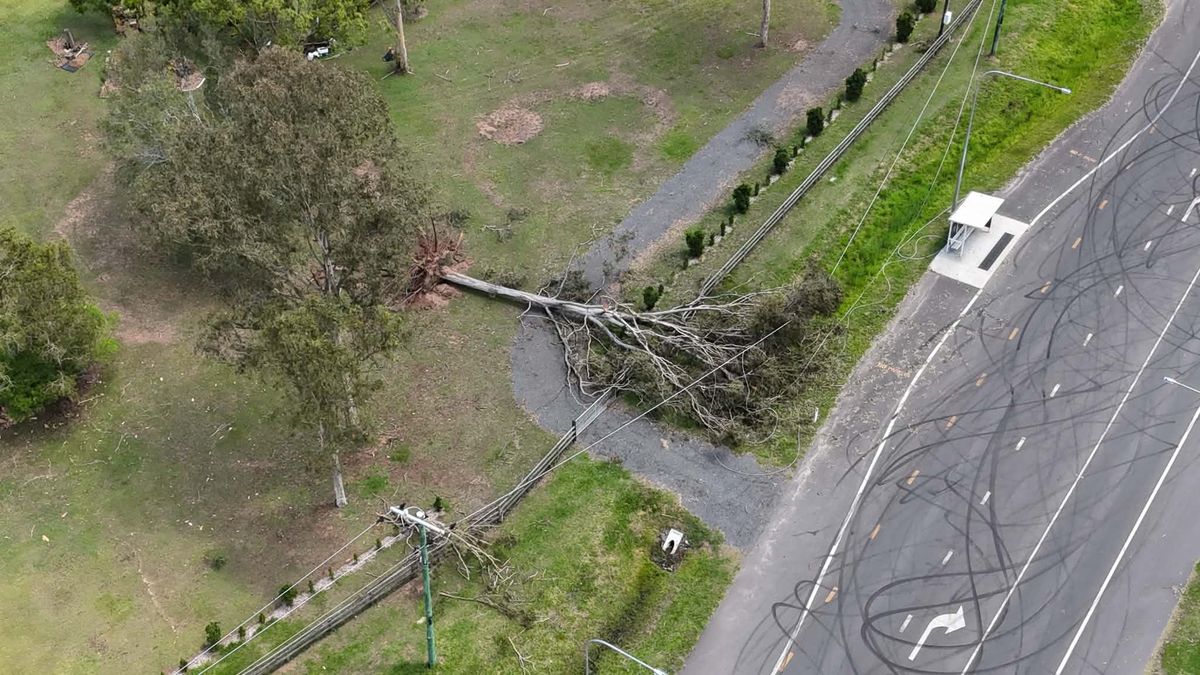
- Powerlines. If a line is down, or a tree is touching one, treat it as live and stay well back. Ring Energex on 13 19 62. Untrained people must stay at least 3 metres from any line, and nobody, including us, goes near a tree in the wires until Energex has made it safe. The drone shot below is why: that gum took the service line and the pole down with it, and the wires are lying across the driveway.
- Water coming in. SES on 132 500 for a tarp and temporary make-safe on the roof. They’re volunteers, they’re flat out, and they don’t cut up big trees. They’ll stop the rain.
- Photos. Before anyone moves a branch. Wide shot of the tree and where it came from, the damage it did, the inside of the house if water’s in. Dated, on your phone, as many as you like.
- Your insurer. Ring them and lodge the claim. Most have a 24-hour line. Get a claim number.
- Us. Call 1300 239 626 or send the photos through the quote form with your suburb and we’ll put you in the queue.
What is a “make-safe”, and who does it?
You’ll hear the word a lot this week. The Insurance Council of Australia defines a make-safe as the immediate work that stops further damage or makes the site safe to visit. On a tree job that means:
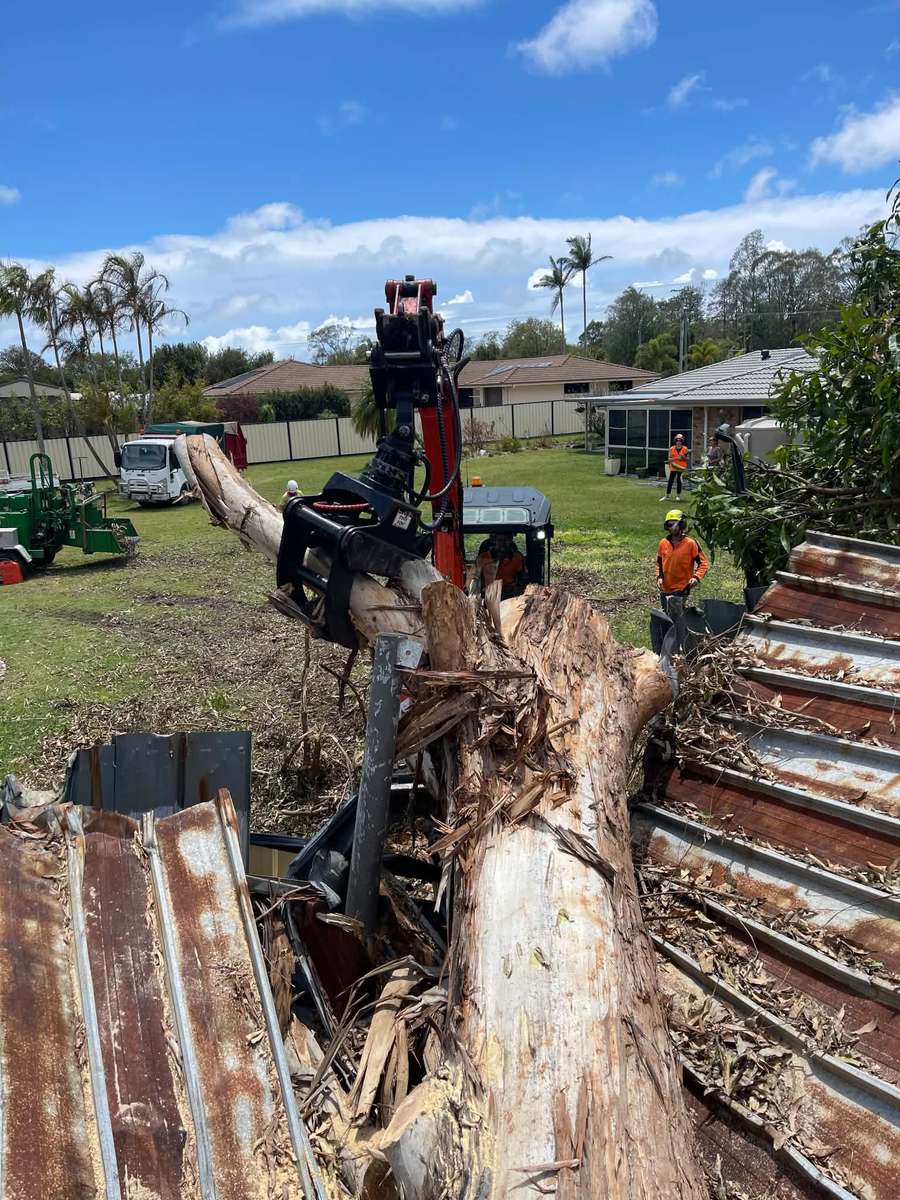
- Taking the weight of the trunk with the excavator grab or a crane before anyone cuts, so the tree comes off the roof rather than dropping through it.
- Cutting it down in sections and getting it clear of the building so the roofer or builder can tarp and start repairs.
- Bringing down hangers, the limbs torn off but still caught in the canopy, before they fall on someone.
- Dealing with the half of the tree still standing if it’s split, leaning or has lifted its root plate.
- Clearing the driveway and the access so tradies and assessors can get in.
Insurers can appoint their own make-safe contractor, and some will. Plenty of people don’t want to wait a week for that, and your policy generally doesn’t require you to. If you get a tree company in yourself, tell your insurer you’re doing it and keep every document we give you. If a builder or assessor turns up that you weren’t expecting, ring your insurer and confirm they sent them. IAG put a warning out on Thursday about door-knockers “falsely claiming to represent insurers” after this storm. Ask for the ABN and the certificate of insurance, and if they haven’t got either, shut the gate.
Will insurance cover the tree removal?
Usually, where the tree has damaged an insured building. Most home and contents policies cover removing a tree that has fallen on the house, garage, shed, fence or carport, because you can’t repair the building with the tree still on it. Some policies also cover clearing a tree that fell and missed everything; many don’t, or cap it. Read your product disclosure statement or ask the claims line straight out: “Is tree removal covered, and is there a limit?”
A few things people get wrong every storm season:
- Your neighbour’s tree on your house is your insurer’s job. You claim on your own policy; the insurers sort out who pays between themselves. We’ve written the long version in who pays when a tree falls on a fence.
- A tree that fell into the yard and hit nothing is a clean-up, not a claim, unless your policy says otherwise. Ask before you assume.
- The stump is usually not covered. Grinding it is a separate line, and we’ll quote it separately so it’s clear.
- If you’ve still got unrepaired damage from last November’s hailstorm, and plenty of Logan homes do, the insurer will need to separate the two events. Photos of what was already there before Wednesday help you here.
How we make your insurance claim faster
This is the bit that matters once the tree is off. An assessor’s job is to work out what happened, what it cost and whether it’s covered. Give them that in one go and the claim moves. Make them chase it and it sits in a pile with the other few thousand from this storm. Here’s what every storm job from us comes with:
- Dated photos, before and after. The tree where it landed, the failure point (the torn root plate, the split trunk, the snapped limb), the damage underneath, and the site cleared.
- A written description of the failure. Species, rough height and trunk size, what failed and why (uprooted in saturated ground, trunk split at a fork, limb torn out), and what it landed on. Written by a qualified arborist, not a bloke with a saw.
- An itemised tax invoice. Make-safe, removal, waste and stump as separate lines, so the assessor can approve the covered parts without arguing about the rest.
- Certificates of currency for public liability and WorkCover, because the first thing a claims officer checks is whether the contractor was insured.
- An AQF Level 5 arborist report if the insurer asks for one. Some want an opinion on why the tree failed, or an assessment of the trees still standing before they’ll pay. We write arborist reports for exactly this.
- A phone call to the assessor if they want one. Happy to talk to them, send them the photos directly and tell them what we found.
We can’t lodge the claim for you and we can’t promise what your insurer will pay. What we can do is hand you a file that answers every question they’ll ask, on the day the tree comes off. That’s what speeds things up.
Do I need council approval to remove a storm-damaged tree?
For a tree that’s already on the ground, no. For a damaged tree that’s still standing, it depends on the council:
- Logan City Council: most house blocks under 5,000 square metres outside environmental or rural zones are exempt under the Planning Scheme 2015, and native vegetation within 10 metres of a house can be cleared for bushfire protection. Acreage and anything under a biodiversity or waterway overlay, check first. Our Logan council tree rules page has the detail.
- Brisbane City Council: a protected tree that is an immediate hazard can be removed, but you need photos before it comes down and an arborist’s report to council within 10 business days. We take the photos as a matter of course and can write the report. See our Brisbane council tree rules.
- Ipswich City Council: approval can depend on your zone and overlays. Check ePlan or ring council. See Ipswich council tree rules.
When in doubt, ask us. We deal with all three councils every week and we’d rather tell you than have you guess.
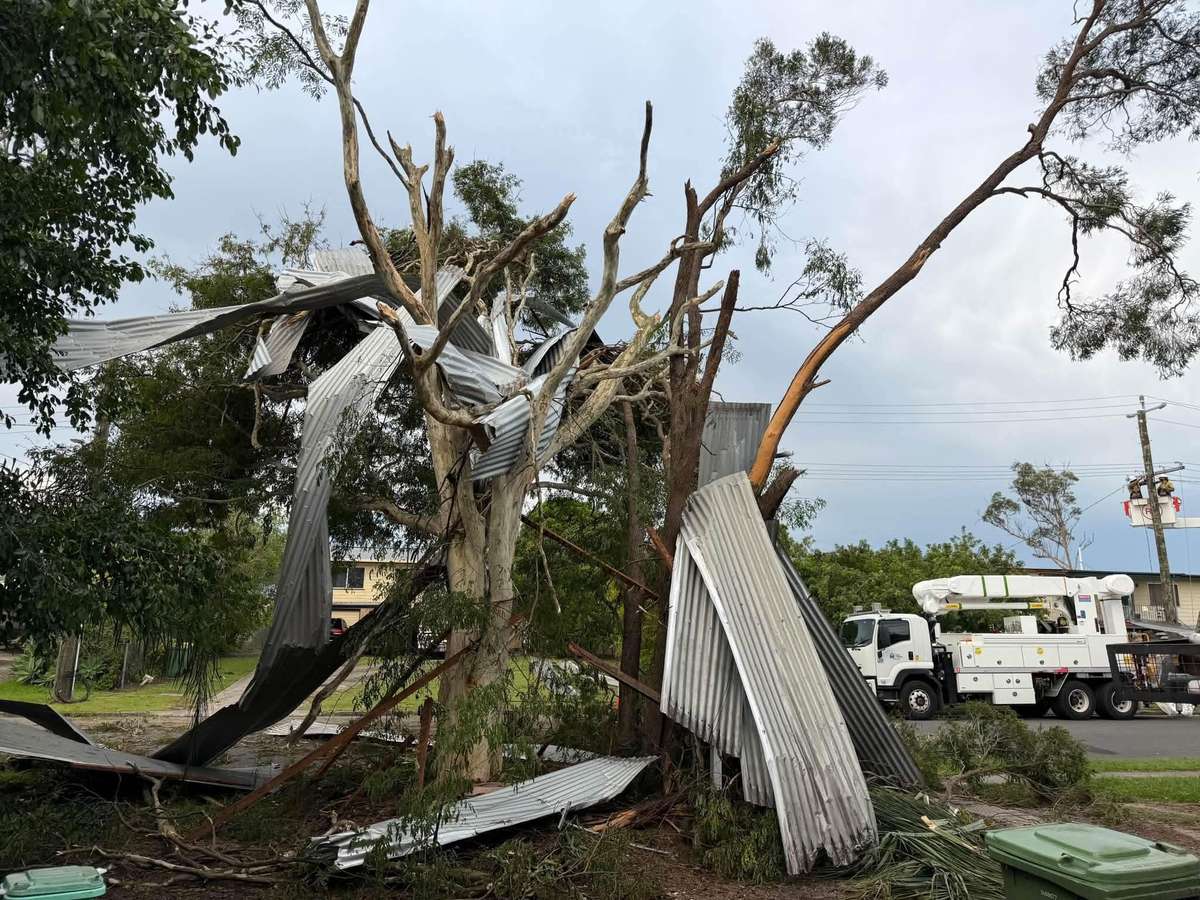
The tree is still standing but it’s split or leaning. Is that an emergency?
Treat it as one if anything is underneath it. Wednesday’s wind left a lot of trees that didn’t fall but moved: trunks cracked at a fork, root plates lifted out of soft ground on one side, big limbs torn half off and hanging. With more storms forecast, those are the trees that come down next. Keep cars and kids out from under them, send us a photo, and we’ll tell you whether it needs to come out now or can wait for a proper assessment. Our dangerous tree removal page covers what we look for.
And the trees that look fine: walk around them before the next cell. Look up for hangers, look down for cracks in the ground around the base, look at the big limbs over the roof. Ten minutes with your phone is worth doing.
Where are the storm crews working?
All of Logan, from our yard at Ellen Grove. The suburbs that copped it worst are the ones we’re in most: Crestmead, Marsden, Chambers Flat, Jimboomba, Logan Village, Waterford West, Regents Park, Heritage Park, Munruben, North Maclean, Kingston and Yarrabilba, plus Greenbank and Park Ridge on the way through.
Honest answer on timing: we triage. Tree on the house with rain coming in goes before tree on the back fence. We’ll tell you where you sit in the queue rather than promise a time we can’t keep. If the phone’s engaged, the form with photos gets you a call back in order. Our emergency tree removal page has the full run-down of how a storm job goes.
Stay off the roof, stay away from the wires, and ring us on 1300 239 626. We’ll get the tree off and give you the paperwork to get the rest sorted.
Frequently asked questions
Is it safe to cut up a fallen tree myself after the storm?
Small branches on the ground, yes. Anything resting on a roof, a fence, a car or another tree, no. A trunk under load is in tension on one side and compression on the other, and cutting it in the wrong spot makes it spring, roll or pinch the bar and kick the saw back at you. Add a wet roof and a ladder and the odds get worse. Leave anything with weight above your head or on a structure to a crew with a grab and a harness.
My neighbour's tree fell on my house. Who pays?
Claim on your own home insurance. Your insurer repairs your damage and decides afterwards whether to recover anything from the neighbour, which usually only happens if the tree was known to be dangerous and they'd been told. Get the tree off, keep the photos, and let the insurers sort it out between themselves.
Will my insurer pay for tree removal if the tree didn't hit anything?
Often not. Most policies cover removing a tree that has damaged an insured building, because you can't repair the building otherwise. Clearing a tree that fell in the yard and missed everything is covered by some policies, capped by others and excluded by the rest. Ask the claims line directly and check your PDS before you assume.
How quickly can you get to a storm job in Logan?
It depends on the day and what's on what. After Wednesday's storm every tree company in South East Queensland has a phone that won't stop, so we triage: a tree on a house with rain coming in goes before a tree on a back fence. Send photos through the quote form with your suburb and we'll ring you back in order and tell you honestly where you sit.
Do you deal with my insurer directly?
We can't lodge or manage the claim for you, but we give you everything the assessor needs on the day the tree comes off: dated before-and-after photos, a written description of how the tree failed, an itemised invoice with make-safe, removal, waste and stump as separate lines, our certificates of currency, and an AQF Level 5 arborist report if they ask for one. We'll also talk to the assessor directly if they want.
Can you grind the stump at the same time as the storm clean-up?
Yes, and it's usually cheaper to do it in the one visit than to come back. Just know that the stump is normally a separate line on the quote and often isn't covered by the insurance claim, so we keep it separate on the invoice so you can see exactly what's what.
