
You have 0 items in your cart
Can hail damage trees? Yes, and in South East Queensland it does every November. Hail strips leaves, bruises and tears bark on the upper side of branches, snaps twigs and small limbs, and leaves wounds that borers and rot get into over the following months. Most mature native trees recover on their own. The ones to worry about are the trees that were already struggling, the young smooth-barked ones, and anything the hail hit together with the wind that usually comes with it.
That is the short answer we give on the phone the morning after a cell has come through Logan. The rest of this page is what to look for when you walk the yard, which trees bounce back and which do not, and the handful of things that mean you should ring an arborist rather than wait and see.
Can hail damage trees, or is it just the leaves?
It is more than leaves, but the leaves are what you notice first. After a decent hail storm the ground under a jacaranda or a gum looks like someone has been through with a mulcher: shredded foliage, green twigs, flower litter everywhere. That part looks dramatic and matters least. A healthy tree in November has the whole growing season ahead of it and will push a new flush within weeks.
The damage that counts is on the wood. Hail comes in at an angle with the wind, so it hits the top and windward side of every branch. On thin or smooth bark that leaves bruises and small tears, hundreds of them, all on the same face of the tree. Each one is a wound. On its own a wound that size is nothing; a tree seals over it. Hundreds of them on a tree that is already short of water in an El Niño spring is a different story, because the sealing uses energy the tree does not have and every open wound is a door for longicorn borers and fungal rot.
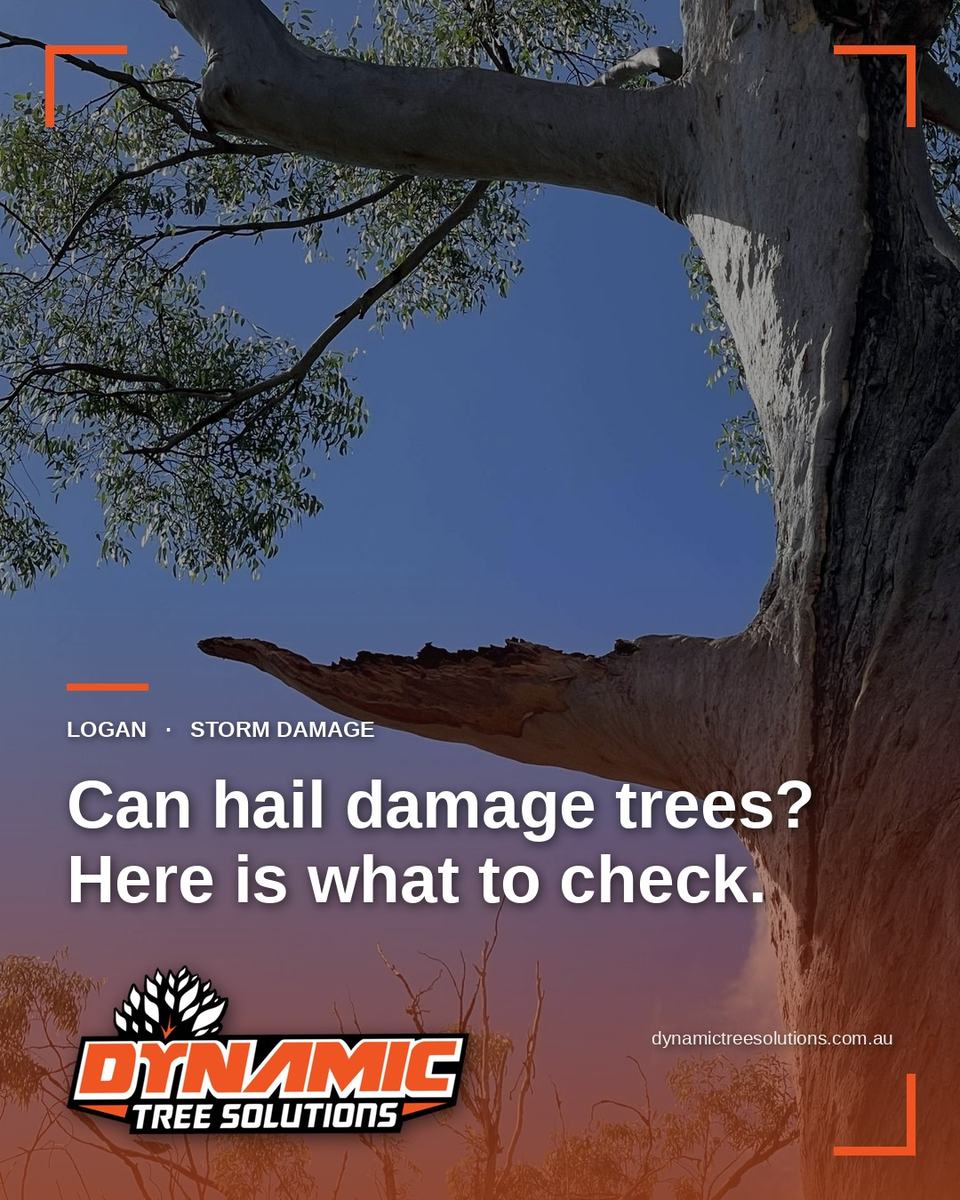
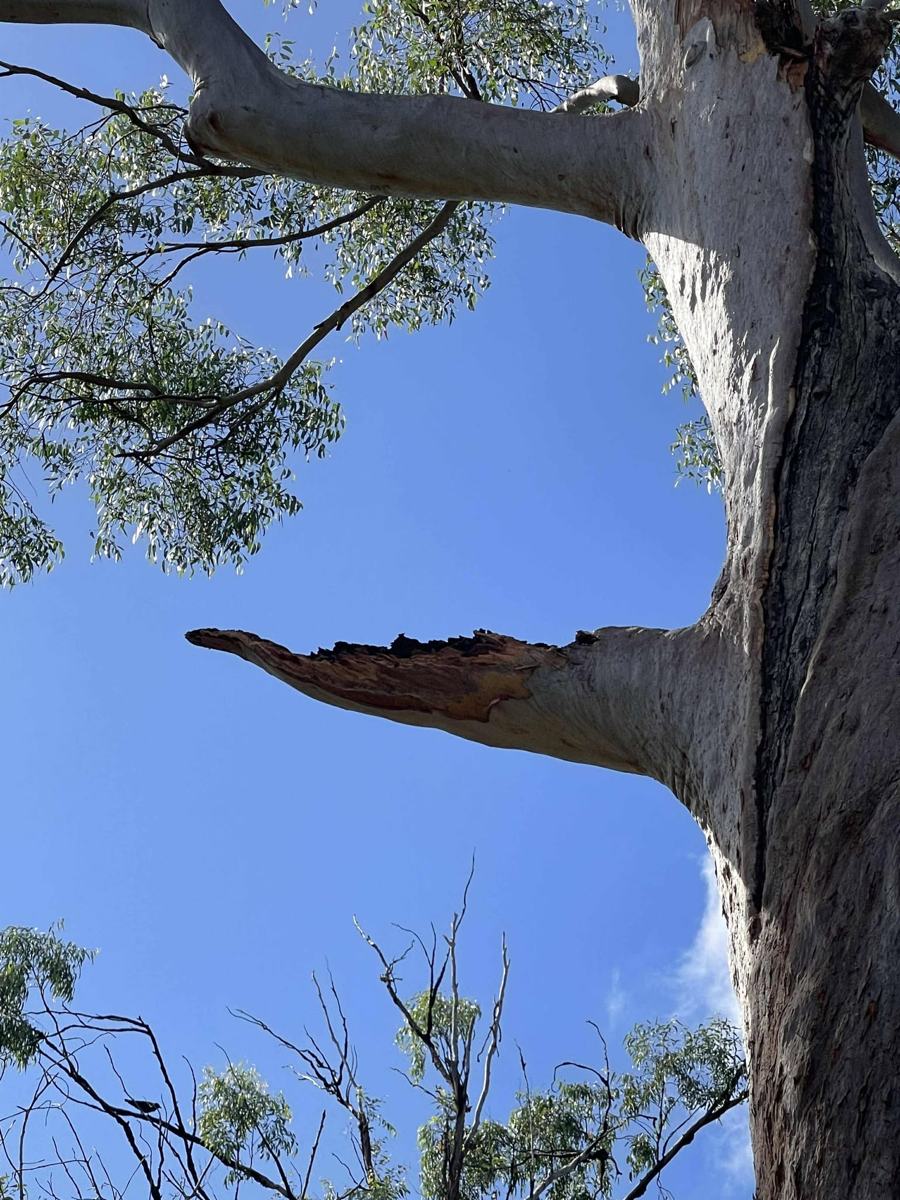
Then there is the hail nobody gets in a backyard in Brisbane. Golf-ball and bigger, which this corridor does see, breaks twigs and pencil-thick branches outright and can snap small limbs where they join. Add the wind the cell brought with it and that is when you get the limb torn out of a fork, which is what the photo on this page shows.
Can hail kill trees?
Rarely on its own, and almost never a mature native tree. Gums, bloodwoods and ironbarks are built for losing their canopy. They carry dormant buds under the bark that fire the moment the leaves go, which is why a gum that looks dead after a storm can be fuzzy with new growth by Christmas. A jacaranda or a poinciana will drop everything and leaf back out. Camphor laurels, unfortunately, shrug it off entirely.
What hail can do is finish a tree that was already on the way out, or start a slow decline that takes a couple of years. A gum with dieback in the crown, a drought-stressed tree on a hard-packed block, a tree with a fungal problem at the base: for those, losing the leaves and copping a few hundred bark wounds in one afternoon can be the push. You do not see the result in November. You see it the following autumn when the canopy thins and the borer holes show up.
Young trees are the other exception. A two-year-old street tree or an advanced planting with thin bark can be ringbarked in patches by heavy hail, and a sapling that gets its leader snapped will grow crooked for the rest of its life unless someone trains it.
What size hail does damage?
The Bureau calls it severe once the stones reach about two centimetres across. In practice the yard tells you:
- Pea to marble size. Leaves and flowers shredded, maybe some bruising on soft new growth. The tree will not notice by December.
- Golf-ball size. Bark bruised and split on the windward side, twigs and small branches broken, fruit trees stripped. Worth a walk around the tree for hangers.
- Cricket-ball size and up. Small limbs snapped, big wounds in the bark, cars and roofs damaged. This is the hail Springfield and the western corridor copped a few years back that stripped trees to the trunk. Everything on this page applies, and there will be hangers.
The wind matters as much as the stone. A cell dropping golf-ball hail in still air does far less to the wood than the same hail with a 90 km/h gust front in front of it. Most of the tree damage we clean up after hail storms around Park Ridge and Browns Plains is really wind damage with hail on top. We have a separate post on why trees fall in storms and which ones to worry about.
What should I check on my trees after a hail storm?
Wait for the weather to clear, then do this walk before you start raking. Ten minutes, from the ground, no ladder.
- Hangers. Look up into the crown for branches that have broken but not fallen. They are held by a strip of bark or wedged in a fork and they come down in the next breeze. Anything over a roof, a driveway, a trampoline or the clothesline is the first thing to deal with.
- Split unions. Where a big limb joins the trunk, look for a fresh crack or a gap you can see sky through. A limb that has partly torn out will not heal back on. It has to come off.
- Bark wounds. Check the windward side of the trunk and main limbs. Scattered bruises are fine. Long strips of bark lifted or a wound that goes most of the way around a stem is not.
- The ground. If the wind was strong, look at the soil on the opposite side to any lean. Lifted turf or a crack opening up means the root plate has moved, and that is a tree to keep people away from today.
- The service line. If a branch is resting on the line from the pole to your house, do not touch it, do not pole-saw it. Energex trims the street lines; the service line is your side of the fence, and anything near it is a job for a crew trained to work inside the exclusion zone.
- The gutters. Not a tree problem, but a hail storm fills them with shredded leaf in one go. Clear them before the next downpour.
Take photos of anything broken before anyone touches it, with the house in the frame. Insurers ask, and it saves an argument later.
Which trees recover from hail damage, and which ones need an arborist?
Leave alone: a mature gum, jacaranda, poinciana, bottlebrush or silky oak that has lost leaves and small twigs but has no broken wood and no cracks. Water it if the ground is dry, mulch it, and let it get on with the job. Do not fertilise it to “help”, and do not paint the wounds with anything. Wound sealants trap moisture and slow the tree’s own sealing. Every arborist standard in the country says leave them open.
Watch: cocos palms and other palms with a smashed spear, young trees with bark stripped in patches, fruit trees with a lot of broken wood. Clean cuts back to healthy wood on anything broken, and keep an eye on them through summer.
Ring someone: any hanger over a structure, any limb torn at the union, any trunk crack, any lean that was not there last week, anything touching a powerline. The limb in the photo tore out of a smooth-barked gum on a block south of Brisbane after a storm, leaving a strip of bark peeled down the trunk below it. The owner wanted to leave it because the tree “looked fine otherwise”. It was not fine; the next wind would have finished the tear and dropped the whole limb across the fence. We took it off clean at the collar so the tree could seal the wound, and the tree is still standing.
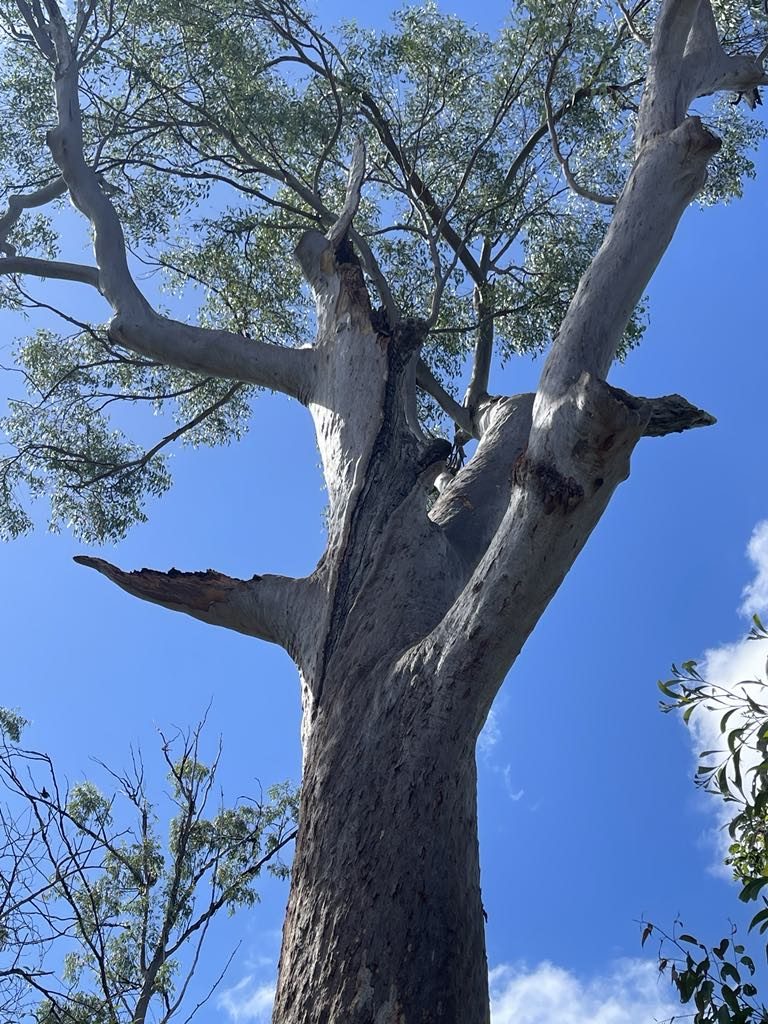
If a tree is already down or something is on the house, that is emergency tree removal and it does not wait for business hours. For the ones you are unsure about, a visual tree assessment gives you a straight answer in writing. The big white gum pictured below came to us that way: hail and wind had snapped two major limbs, the tear-outs had been open for a couple of seasons, and the decay had got in. That one was past pruning and came out.
Why does the Logan corridor get hit so often?
Storm cells in SEQ mostly build over the ranges to the west and south-west in the afternoon and track north-east. That puts Marsden, Browns Plains and Park Ridge right under the path on a lot of November afternoons, and the new estates out there have young trees with thin bark and not much else to slow the wind. The Bureau’s severe weather knowledge centre explains how these cells form, and the Get Ready Queensland checklist covers the house side of it. The tree side is simple: deadwood out before the season, weight off the long limbs over the roof, and a walk around the yard after every storm.
If storm season has already found a weak spot in one of your trees, or you have a hanger you cannot reach, call Dynamic Tree Solutions on 1300 239 626 or use the quote form. We will tell you what can stay and what cannot, and we will not sell you a removal the tree does not need.
Frequently asked questions
Can hail kill trees?
Rarely on its own. Mature gums, jacarandas and poincianas lose their leaves and grow them back within weeks. Hail can finish a tree that was already stressed by drought, dieback or root damage, and heavy hail with wind can snap limbs and tear bark that lets borers and rot in, which shows up as decline over the following year or two.
Does hail damage plants and garden beds?
Yes. Hail shreds soft foliage, flattens annuals and vegetables and bruises fruit. Most established shrubs and perennials recover once you cut back the broken stems and keep the water up. Palms with a smashed central spear and young trees with stripped bark are the ones to watch.
What size hail does damage to trees?
Pea to marble size strips leaves and flowers. Golf-ball size bruises and splits bark on the windward side and breaks twigs. Cricket-ball size and up snaps small limbs and leaves large wounds. The Bureau calls hail severe from about two centimetres across, and the wind that comes with it usually does more to the wood than the stones.
Can plants survive hail damage?
Most do. Prune broken stems back to healthy wood with a clean cut, water if the soil is dry, mulch, and leave the plant to push new growth. Do not fertilise straight away and do not paint wounds with sealant; it traps moisture and slows the plant's own sealing.
Should I seal hail wounds on a tree?
No. Wound paints and sealants are not recommended under the Australian pruning standard. A tree seals its own wounds from the edges and sealant gets in the way. Make clean cuts on anything broken, at the branch collar, and leave the rest alone.
When should I call an arborist after a hail storm?
Any hanging branch over a roof, driveway or play area, a limb torn at the union, a fresh crack in the trunk, a lean that was not there last week, or anything touching a powerline. For a tree already down or on the house, ring 1300 239 626 for emergency tree removal.
