
You have 0 items in your cart
In This Guide
- What Makes a Tree “Dangerous”
- Trunk Warning Signs
- Root & Base Warning Signs
- Canopy Warning Signs
- Fungal Brackets & Decay Indicators
- Lean — When to Worry
- Storm-Damaged Trees
- Structural Defects
- High-Risk Species in SEQ
- Target Assessment — What’s Underneath?
- When to Take Immediate Action
- Seasonal Tree Checks
- Frequently Asked Questions
- Book a Professional Hazard Assessment
Every storm season in South-East Queensland, a small number of trees fail catastrophically — onto houses, vehicles, powerlines, and tragically sometimes onto people. The hardest part of those incidents is that the warning signs were almost always visible weeks or months before. Knowing what to look for is the difference between an avoidable disaster and a $400 inspection that saves a property — or a life.
This guide walks through the specific signs that AQF Level 5 consulting arborists look for during a visual tree assessment. We’ll cover trunk indicators, root and base signs, canopy warnings, fungal decay markers, dangerous lean patterns, and storm-damage red flags. By the end you’ll have a checklist you can apply to every significant tree on your property, and you’ll know when DIY observation needs to become a professional callout.
What Makes a Tree “Dangerous”
“Dangerous” isn’t a homeowner opinion — it’s a technical determination based on two combined factors: the probability of failure and the consequence of failure. The international Tree Risk Assessment Qualification (TRAQ) and the UK Quantified Tree Risk Assessment (QTRA) frameworks both work on this combined model:
- High probability + high consequence = imminent removal or major intervention
- High probability + low consequence = monitor or relocate target
- Low probability + high consequence = monitor closely, plan intervention
- Low probability + low consequence = routine monitoring only
This is why two trees with identical defects can get different recommendations — one over a children’s bedroom and one in an empty rear paddock have the same probability but completely different consequences.
The warning signs in this guide affect the probability side of the equation. The consequence side depends on what’s underneath the tree.
Trunk Warning Signs
The trunk is the structural spine of the tree. Failure here is almost always catastrophic — when a trunk fails, the entire tree comes down. These are the trunk-level warning signs to look for:
Cavities and Hollows
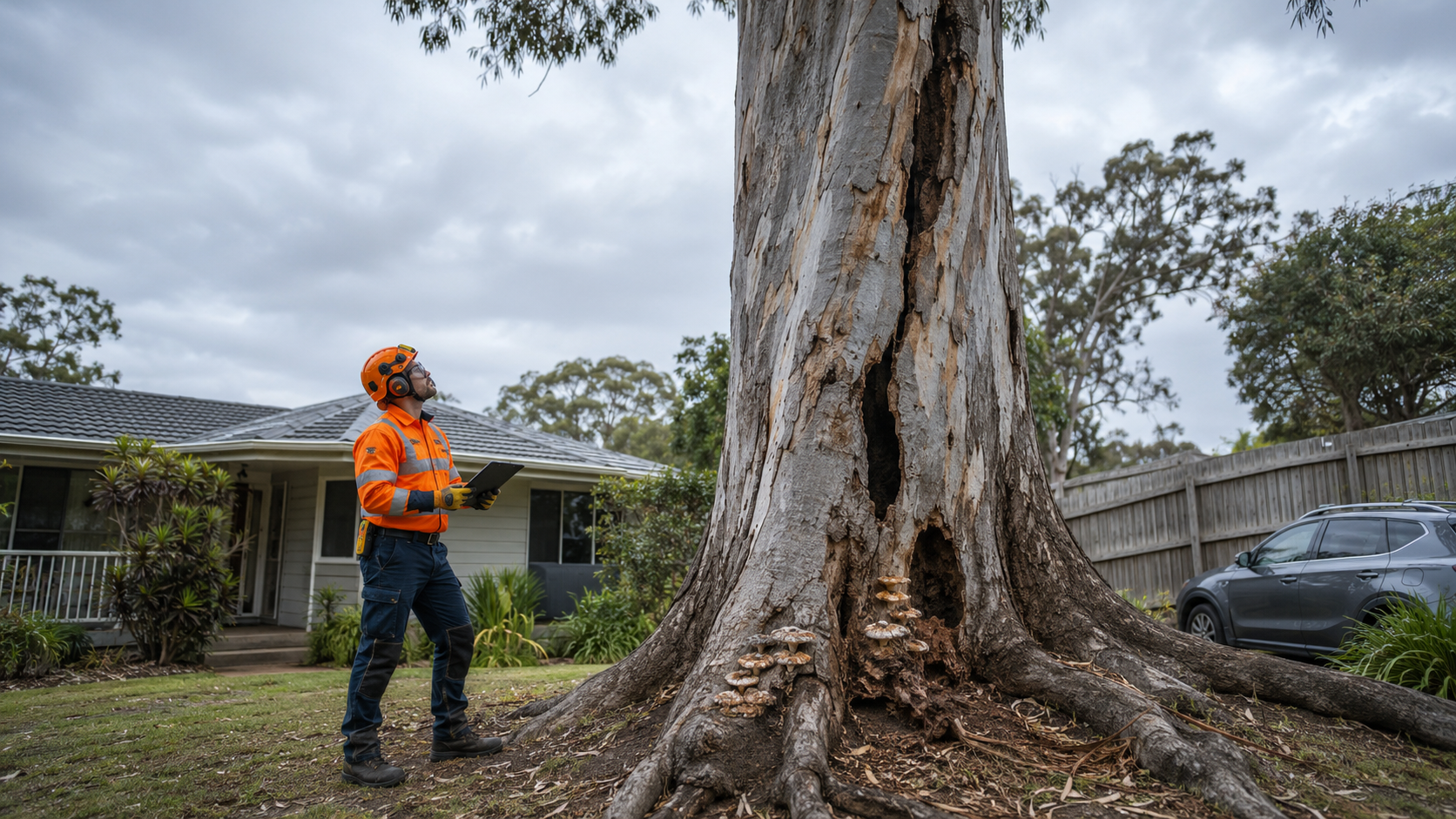
An obvious cavity in the main trunk indicates the tree has lost structural wood in that section. The critical question is how much sound wood remains around the cavity. A general arborist rule: if the sound wood thickness is less than one-third of the trunk radius at that point, the structure is compromised. Small cavities high in the canopy are less critical than cavities in the main butt section.
Cracks Running Vertically
Vertical cracks in the trunk — particularly cracks that have widened over months or seasons — indicate the trunk is splitting under load. Cracks combined with weeping sap (especially on eucalypts) are particularly serious.
Bulges & Swelling
A bulge on the trunk often indicates the tree is trying to compensate for internal weakness. The tree builds extra wood around a weak point — but the bulge itself signals that the internal structure isn’t sound. Combined with cracks or fungal indicators, bulges are a major red flag.
Wound-Wood “Rams Horns”
When a tree tries to seal an old wound but the wound is too large to close, the wound wood grows in a curled “rams horn” pattern. This indicates persistent decay at the wound site that the tree hasn’t been able to wall off.
Bark Loss & Sap Bleeding
Patches of dead or detached bark, particularly with active sap weeping or insect activity, indicate vascular system damage. Trees use the cambium just under the bark to transport water and nutrients — damage to this layer is essentially a circulation failure.
Termite Mudding
Mud galleries running up the trunk are termites accessing the heartwood. By the time termite activity is visible externally, internal damage is typically extensive. Live termite activity on a structural tree is one of the strongest removal triggers.
Root & Base Warning Signs
Root failure is one of the most reliable predictors of catastrophic whole-tree failure. When the root plate loses its grip, no amount of canopy can keep the tree standing.
Soil Cracks at the Base
Look for cracks in the soil within 1-2 metres of the trunk, particularly on the opposite side to any lean. Cracks indicate the root plate is lifting on one side as it loses anchor.
Root Plate Lifting
Visible lifting of the soil and root mat on one side of the tree is a critical failure indicator. In saturated soil after heavy rain, even partially-lifted root plates can fail entirely. After major storms or wet periods, walk around significant trees specifically looking for this.
Mushrooms or Fungal Growth at the Base
Mushrooms or other fungal fruiting bodies in the soil immediately around the base of the tree often indicate root rot. Species like Armillaria (honey fungus) and Ganoderma attack the roots and can collapse a tree without much external warning to the rest of the canopy.
Construction Damage
Trees near recent construction (within the last 3-5 years) are at elevated risk. Soil compaction, root severance, grade changes, and trenching for services all damage root systems in ways that may not show in the canopy for years. If your block has had significant earthworks, treat large nearby trees with extra caution.
Soil Heave on One Side
Even without visible cracks, soil rising on one side of the tree (compared to the surrounding ground level) can indicate the root plate is rotating. Particularly common in the windward direction during strong winds.
Canopy Warning Signs
The canopy is the most observable part of the tree — and it shows several signals of structural and health issues that affect risk.
- Major dead branches in the upper canopy — particularly large branches (over 100mm diameter) that have been dead for more than a season are at high risk of falling during storms
- Recent partial canopy loss — losing 30%+ of the canopy in a single storm leaves the tree structurally unbalanced and more likely to fail in the next major weather event
- Premature leaf drop or autumn colour in summer — indicates stress or disease, often related to root issues
- One-sided canopy thinning — particularly if the thinning is on the side facing wind, can indicate root failure on the opposite side
- Visible mistletoe infestation — heavy mistletoe load weakens host trees and increases breakage risk on affected branches
- Suckering from the base — sometimes indicates the upper tree is failing and the tree is sending out emergency growth from the base
Fungal Brackets & Decay Indicators
Fungal fruiting bodies on a living tree are almost always bad news. The fruiting body is just the visible part — the actual decay is inside the wood. Different fungi indicate different problems:
- Bracket fungi on the trunk — wood decay fungi, often present for years before visible. Identification of the species (white rot vs brown rot vs soft rot) tells you what kind of structural damage is occurring
- Mushrooms at the base — root rot. The tree may look healthy in the canopy but the foundation is failing
- Honey fungus (Armillaria) — attacks the cambium under the bark; visible signs include black bootlace-like rhizomorphs under loose bark
- Ganoderma — large semi-circular brown brackets at or near the base; aggressive root and butt rot
- Phellinus species — perennial bracket fungi indicating long-term decay
- Inonotus — orange to brown brackets, common on eucalypts indicating substantial heartwood decay
Even one visible fungal bracket is a serious indicator. Most arborists treat the presence of brackets on the main trunk as a probable removal trigger pending further investigation — particularly if the brackets are at or near the base.
Lean — When to Worry
Not all leaning trees are dangerous. Many trees lean toward sunlight (phototropic lean) and have compensated by growing extra structural wood on the opposite side. The dangerous lean is the one that’s changed — particularly the lean that has worsened over the past 12 months.
Assessing lean:
- Long-standing lean with compensation buttress — generally not dangerous in itself, often safely managed
- New lean (less than 12 months) — major concern, particularly after storms or wet periods
- Increasing lean over time — almost always indicates progressive root failure
- Lean combined with soil cracks — imminent failure risk
- Lean toward a high-consequence target — increases the consequence side regardless of probability
If you suspect a lean has worsened, take photographs from a fixed reference point (a fence post, a corner of the house) and compare against earlier photos. Even small changes are significant.
Storm-Damaged Trees
Trees damaged in storms but still standing are some of the highest-risk trees on a property. The visible damage often understates the structural impact, and the storm event itself frequently shows that the tree’s failure threshold is lower than previously assumed.
Storm-damage red flags:
- Loss of major scaffold branches (those over 150mm diameter)
- Splits at branch unions, even if the branch hasn’t yet failed completely
- Loss of more than 30% of the canopy in a single event
- Twisting damage to the trunk
- Visible cracks in the upper trunk that weren’t there before the storm
- Root plate disturbance
After major storms, our 24/7 emergency tree response service handles a high volume of inspections specifically because storm-damaged trees that look “okay” from the ground often turn out to be one weather event away from full failure. A storm-damaged tree assessment is one of the highest-value preventive inspections.
Structural Defects
Some trees are dangerous because of how they’re built, not because of damage. Structural defects can be present from young age and become problems at maturity.
Co-Dominant Stems
When a tree has two or more equally-sized main stems competing for dominance, the union between them is mechanically weaker than a single trunk would be. The risk is the tree splitting at the union under wind load.
Included Bark Unions
Where two stems grow with bark pinched between them at the union (a V-shape rather than a U-shape), the union is significantly weaker. Included bark unions are one of the most common storm-failure points.
Heavy End-Weighting
Branches with most of their leaf mass concentrated at the tips (“lions-tailed” by past pruning, or naturally heavy-tipped species) have higher lever-arm forces on the attachment point. End-weighting increases failure probability.
Excessive Horizontal Branch Extension
Branches extending significantly horizontally from the trunk experience extreme lever-arm forces. Combined with end-weighting, horizontal branches are major failure candidates.
Multiple Attachment Decay Points
If multiple branch attachment points show decay (cavities, cracks, fungal indicators), the tree’s overall structural integrity is at risk even if no single defect is critical on its own.
High-Risk Species in SEQ
Some species are statistically more prone to failure in Brisbane conditions:
- Norfolk Island Pine — top-heavy structure, prone to wind throw in storms, particularly when grown outside coastal conditions
- Hoop Pine — single dominant leader, susceptible to lightning strike, branches detach cleanly under load
- Cocos Palm — beyond environmental weed status, mature cocos can drop substantial frond and seed-pod weight unpredictably
- Liquidambar — surface root systems plus rapid growth often produce structural issues at maturity
- Silky Oak (Grevillea robusta) — brittle wood, branches can fail without warning
- Mature Camphor Laurel — heavy crown, surface roots, brittle wood; combined with environmental weed status, often the right call to remove
- Erythrina (Coral Tree) — brittle wood, prone to branch failure in storms
- Old Jacaranda — co-dominant union structure typical; mature jacarandas frequently split at major unions
- Mature Poinciana — wide canopy spread on hollow heartwood-prone species
- Old Wattle (Acacia species) — short-lived genus; mature wattles routinely fail at 25-40 years
None of these species is automatically dangerous, but they all warrant closer scrutiny than the bulletproof natives like spotted gum, blackbutt or ironbark. Our hazardous tree clearing specialists work with the high-risk species frequently across SEQ.
Target Assessment — What’s Underneath?
The same tree with the same defects gets a different recommendation depending on what’s underneath. Map your trees against their targets:
- High-occupancy targets — bedrooms, living areas, regularly-used outdoor spaces, pool areas, driveways, parking. Lower risk tolerance.
- Medium-occupancy targets — sheds, fences, garden infrastructure, garages. Moderate risk tolerance.
- Public infrastructure targets — roads, footpaths, power lines, neighbour property. Council and insurance considerations apply.
- Low-consequence targets — rear paddocks, unfenced bushland, areas with no occupation or infrastructure. Higher risk tolerance allows for preservation strategies.
For trees over high-consequence targets, even moderate risk justifies action. For trees over low-consequence targets, significant defects may still allow preservation with monitoring.
When to Take Immediate Action
Some warning signs warrant immediate professional callout — same day if possible:
- Visible new cracks in the trunk after a storm or wind event
- Sudden lean change, particularly after heavy rain
- Soil cracks or root plate lifting observed for the first time
- Audible cracking or popping from the tree under wind
- Sagging branches over occupied areas after rain or weight events
- Tree contact with powerlines — call Energex first (13 19 62) before any tree work
- Storm-damaged tree with major branches lost over occupied areas
Our emergency response covers all SEQ council areas. For after-hours emergency callouts, phone 0493 787 510 directly.
Seasonal Tree Checks
Tree hazard inspection should follow a seasonal pattern:
- Early Spring (September) — Pre-storm season inspection. Walk every significant tree looking for trunk indicators, fungal brackets, dead wood, and recent changes.
- After Major Storms — Walk-through inspection within 24 hours of significant weather events. Look for new lean, soil cracks, branch loss, and visible damage.
- Mid-Summer (January) — Mid-season check. Storm season is at peak; this is when latent defects often become apparent.
- Late Autumn (May) — Post-storm-season review. Assess what’s changed over the storm period.
- Winter (July-August) — Detailed inspection during dormancy. Easier to see the structural detail without canopy obstruction.
For properties with multiple significant trees or high-consequence targets, a professional annual visual tree assessment is the standard recommendation. The cost is a tiny fraction of the insurance excess for a single tree failure event.
Frequently Asked Questions
How can I tell if a tree is going to fall?
The strongest single predictor is recent change — particularly new lean, new soil cracks, or rapid canopy decline. Trees rarely fall without warning, but the warning signs are sometimes subtle and require looking specifically for them. Fungal brackets on the main trunk, visible cracks, and root plate lifting are major red flags.
Are dead branches in a tree dangerous?
Dead branches that are still attached will eventually fall — the question is when. Small dead twigs are low risk; major dead scaffold branches (over 100mm diameter) over occupied areas warrant prompt removal. Dead wood in the outer canopy can usually be selectively removed; widespread dieback through the canopy indicates a tree-level health problem requiring assessment.
Do mushrooms growing near a tree mean it’s dying?
Mushrooms growing in the immediate base of the tree (within 1-2 metres) often indicate root rot — yes, this is a serious sign. Mushrooms growing further out may be saprophytic (decomposing dead organic matter) and unrelated to the tree’s health. Identification of the fungal species by an arborist clarifies the meaning.
Is a leaning tree always dangerous?
No. Many trees lean toward sunlight and have compensated by growing extra wood on the opposite side. The dangerous lean is the one that has changed recently — particularly post-storm or post-wet-period. Take photographs from fixed reference points and watch for change.
Can a tree fall without warning?
Genuine “no warning” failures are rare — there are almost always warning signs. What’s more common is that the warning signs weren’t recognised. Internal decay, root failure, or trunk damage can all be present months before the tree fails, but visible only to trained observers.
What should I do if I think my tree is dangerous?
Take photographs of what concerns you. Keep clear of the tree’s fall zone. Engage a qualified consulting arborist for a Visual Tree Assessment — they’ll quantify the risk and provide a recommendation. Don’t attempt removal yourself, and don’t engage an unqualified operator just because they’re cheaper.
Do insurance companies require dangerous tree assessments?
Some do, particularly after significant tree-related claims. Many property insurance policies have clauses requiring reasonable maintenance of trees on the property, and a professional risk assessment can document that reasonable maintenance has been performed.
Are trees in bushland naturally more dangerous than urban trees?
Bushland trees grow in their natural community and have generally developed appropriate structure for the conditions. Urban trees often have impaired root systems (soil compaction, root severance during construction), unnatural targets close by, and altered wind patterns. Statistically, the riskiest trees are often urban specimens with compromised root systems.
Book a Professional Hazard Assessment
If you’ve worked through this guide and you have specific concerns about a tree on your property — or you’d like a professional eye over all the significant trees as a routine pre-storm-season inspection — our team conducts visual tree assessments across all five SEQ council areas.
Every assessment includes documented inspection of trunk, root and canopy condition, identification of any structural defects, target risk mapping, and a written recommendation with photographic evidence. For trees identified as significant hazards, we provide immediate temporary mitigation recommendations and timeline for full intervention. Our dangerous tree removal specialists handle the high-risk follow-up work where needed.
Phone 1300 2DYNAMIC (1300 239 626) to book a tree hazard assessment, or send details via the contact form and we’ll come back within one business day. For emergency callouts, phone 0493 787 510.
