
You have 0 items in your cart

Storm season tree services are the jobs that make a tree less likely to drop a limb or go over in a storm: an inspection, dead-wooding, weight reduction on long limbs, clearing the roof and the service line, and taking out trees that are already failing. In South East Queensland the season starts on 1 October, and the worst of the storms and hail usually turn up between October and December. Book before the first big one. After it, every tree crew in town is on emergency work.
Every year it goes the same way. September is quiet. Then the first proper cell rolls through on a Thursday arvo, and by Friday morning the office phone sounds like a pokie room. Half of those calls are for trees that were already telling the owner something was wrong. A dead limb that had been hanging there since winter. A crack in a fork. A gum leaning a bit further over the carport than it did last year.
So this is the plain version of what storm season tree services are, which trees we look at first, and why the timing matters more than most people think.
What do storm season tree services actually include?
It is not one job. It is a short list, and most yards only need two or three things off it.
- A proper look. An arborist walks the block and checks each tree from the roots up: the base, the trunk, the forks, the canopy. Most problems show up from the ground if you know where to look. If you need it in writing for an insurer, a body corporate or council, that is an arborist report.
- Dead-wooding. Dead branches come out of the canopy before the wind does it for you. This is the most common storm prep job we do. More on our dead-wooding page.
- Weight reduction. Long, heavy limbs that reach out over a roof, a driveway or the kids’ trampoline get shortened back to a sound branch, so there is less sail and less leverage on the join.
- Clearance. Branches rubbing on the roof, sitting in the gutters or growing toward the powerline that runs to your house.
- Removal. Only when the tree is dead, splitting or coming out of the ground. We would rather prune a good tree than remove it.
All pruning is done to the Australian Standard for pruning amenity trees, AS 4373. In plain words, that means cuts in the right place and no lopping the top off. A topped tree looks tidy for a year, then throws a mess of weak new shoots that snap off in the next storm. You pay twice.
We have a longer homeowner checklist in our guide on how to prepare for storm season. This post is about the tree work itself.
Why book storm season tree services before the first storm?
Three reasons, and none of them are a sales pitch.
One, the queue. Once a storm hits, emergency jobs go first. They have to. A tree through a roof or across a driveway beats a tidy-up every time. That means booked pruning work gets pushed back, and new enquiries wait longer again. Ask the office what the current lead time is when you ring. It is shorter today than it will be the week after the first hail.
Two, the tree is easier to work on. A standing tree can be climbed, rigged and taken apart in a controlled way. A tree that has half failed is a different animal. It is loaded with tension in places you cannot see, it is often hung up in the neighbour’s tree or on a fence, and it takes more gear and more time to make safe. Prevention is the simpler job. It nearly always is.
Three, the weather is on your side for about five more minutes. We cannot climb in lightning or high wind, and we do not put people in a harness in a wet tree with a chainsaw if we can avoid it. Fine October days are when the work gets done.
This summer has an extra twist. A strong El Niño was declared in June 2026, which points to a hotter, drier season. Dry, heat-stressed gums shed limbs, and spring hail storms still happen in dry years. We wrote about that in what El Niño means for Brisbane trees.
Which trees do we look at first?
When we walk a yard before storm season, we do not start with the biggest tree. We start with the one that has something to land on. A scruffy gum in the back corner of an acreage block can wait. A healthy-looking one over the main bedroom cannot.
| Tree | What we look for | Usual fix |
|---|---|---|
| Gums (eucalypts and spotted gums) | Dead wood in the canopy, long heavy limbs over the house, old tear-out wounds, hollows | Dead-wooding and weight reduction |
| Cocos palms | Dead fronds and heavy seed pods hanging over paths, cars and pool fences | Clean the head, or remove the palm |
| Leopard trees and jacarandas | Tight V-shaped forks with bark trapped in the join, which split under load | Reduce the weight on one side of the fork |
| Camphor laurels | Big dense canopies that catch a lot of wind, plus old decay | Thin and reduce, or remove (it is a pest tree) |
| Anything leaning | Fresh cracks in the soil or a lifted mound on one side of the base | Urgent inspection. This one does not wait. |
That last row matters most. A tree that has always leaned is usually fine. A tree that has started to lean is not. If the ground at the base is cracked or lifting, keep people away from it and call us that day.
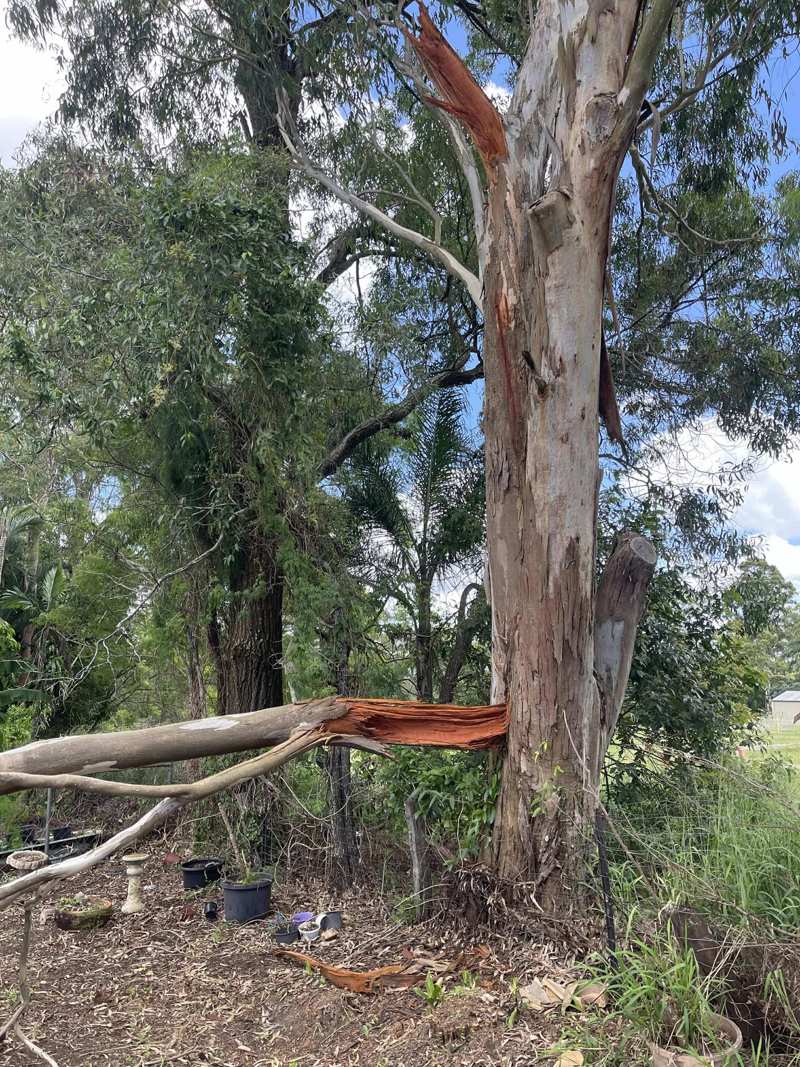
The photo above is the sort of thing we get called to after the fact. Long, heavy limbs fail at the join, and when they go they often take a strip of trunk with them. Taking weight off the end of a limb like that before the season is the whole point of storm prep. Afterwards, the conversation is about whether what is left can stay.
What does storm prep look like in Springfield, Goodna and Redbank Plains?
A lot of our October work sits in the Ipswich corridor, just up the road from our yard at Ellen Grove.
In the newer estates around Springfield, the trees went in when the houses did. They were small then. They are fast growers, they were planted close to fences and eaves, and plenty of them are now big enough to do damage but have never had a pruning cut in their lives. First-time structural pruning is the usual job there.
Goodna is the opposite. Established yards, mature trees, and gums that have been dropping the odd branch for decades. There it is mostly dead-wooding and getting weight off the limbs that hang over roofs and sheds.
Redbank Plains is a mix of both, often in the same street. New builds backing onto older blocks with big trees along the fence line. If the tree that worries you is next door, talk to the neighbour first. We can quote the job for both of you so nobody is guessing.
Do you need council approval for storm prep pruning?
Often not, but check before anyone starts a saw.
All three of those suburbs are in Ipswich City Council. Approval there depends on the zone and the overlays on your block, so look your address up on council’s ePlan or ring them. Our page on Ipswich council tree regulations covers the basics.
In Brisbane City Council, start with the Protected Vegetation map. Even on a protected tree you can prune up to 20% of the live foliage in any 12 months without a permit, and that covers a lot of storm prep. A tree that is an immediate hazard can also be dealt with first, as long as photos and an arborist report go to council within 10 business days.
This is a guide, not a legal ruling. Check with council or ask us. We do this every week.
What can you check yourself this weekend?
You do not need a ticket to walk around your own yard. It is Get Ready Queensland Week, so it is a good weekend for it. Ten minutes, cup of tea in hand.
- Look up. Any dead branches, or broken ones hung up in the canopy?
- Look at the forks. Any cracks, or dark weeping stains running down from a join?
- Look at the base. Any lifted soil, new cracks in the ground, or mushrooms growing off the trunk?
- Look at the roof. Anything touching it, or close enough to hit it in a blow?
- Look at the line from the street to your house. Anything growing into it?
On that last one, look and do not touch. Energex trims around the street powerlines, but the service line to your house is the owner’s job, and only authorised contractors can work near it. There is a 3 metre exclusion zone for anyone untrained. Energex has the detail on its trees and powerlines page.
The small stuff you can do yourself. Pick up loose branches and palm fronds, clear the gutters, and get the pile out of the yard before it becomes something the wind can throw. The big stuff, anything off a ladder or above your head, is where people get hurt. Leave that to a crew with ropes and insurance.
What if the storm beats you to it?
Then it is a different job, and we do that too. Stay well clear of any tree or branch that is on a powerline and report it to Energex. Keep everyone out from under hanging limbs. Take photos for your insurer before anything is moved, then call us. Our emergency tree removal crews work through storm season.
But the easier phone call is the one you make now.
Ready to book?
Call the office on 1300 239 626 or send the details through our quote form. Tell us the suburb, the tree that worries you and what is underneath it, and we will get an arborist out for a look.
Frequently asked questions
What are storm season tree services?
They are the jobs that lower the chance of a tree failing in a storm: an arborist inspection, dead-wooding, weight reduction on long limbs, clearing branches off the roof and the service line, and removing trees that are already dead or splitting. Most yards only need two or three of these.
When should I book storm season tree work in Brisbane?
Before the first big storm. The South East Queensland storm season starts on 1 October and the worst storms and hail usually come between October and December. Once a storm hits, emergency jobs go first and booked pruning work waits longer.
Which trees should be checked first before storm season?
Start with any tree that has something to land on: the house, the carport, the driveway or the powerline to the house. Then look at gums with dead wood or long heavy limbs, cocos palms with dead fronds and seed pods, trees with tight V-shaped forks, and anything that has started to lean.
Do I need council approval to prune a tree before storm season?
Often not, but check first. In Brisbane City Council you can prune up to 20% of the live foliage in 12 months without a permit, even on a protected tree. In Ipswich it depends on the zone and overlays on your block, so check with council or ask us.
A branch is touching the powerline to my house. Who fixes it?
Energex trims around the street powerlines, but the service line from the street to your house is the owner's responsibility. Do not touch it yourself. There is a 3 metre exclusion zone for untrained people and only authorised contractors can work near powerlines.
What if a tree comes down before you get to me?
Keep everyone away from it, stay clear of anything on a powerline and report that to Energex, take photos for your insurer, then call us. Our emergency crews work right through storm season.
