
You have 0 items in your cart
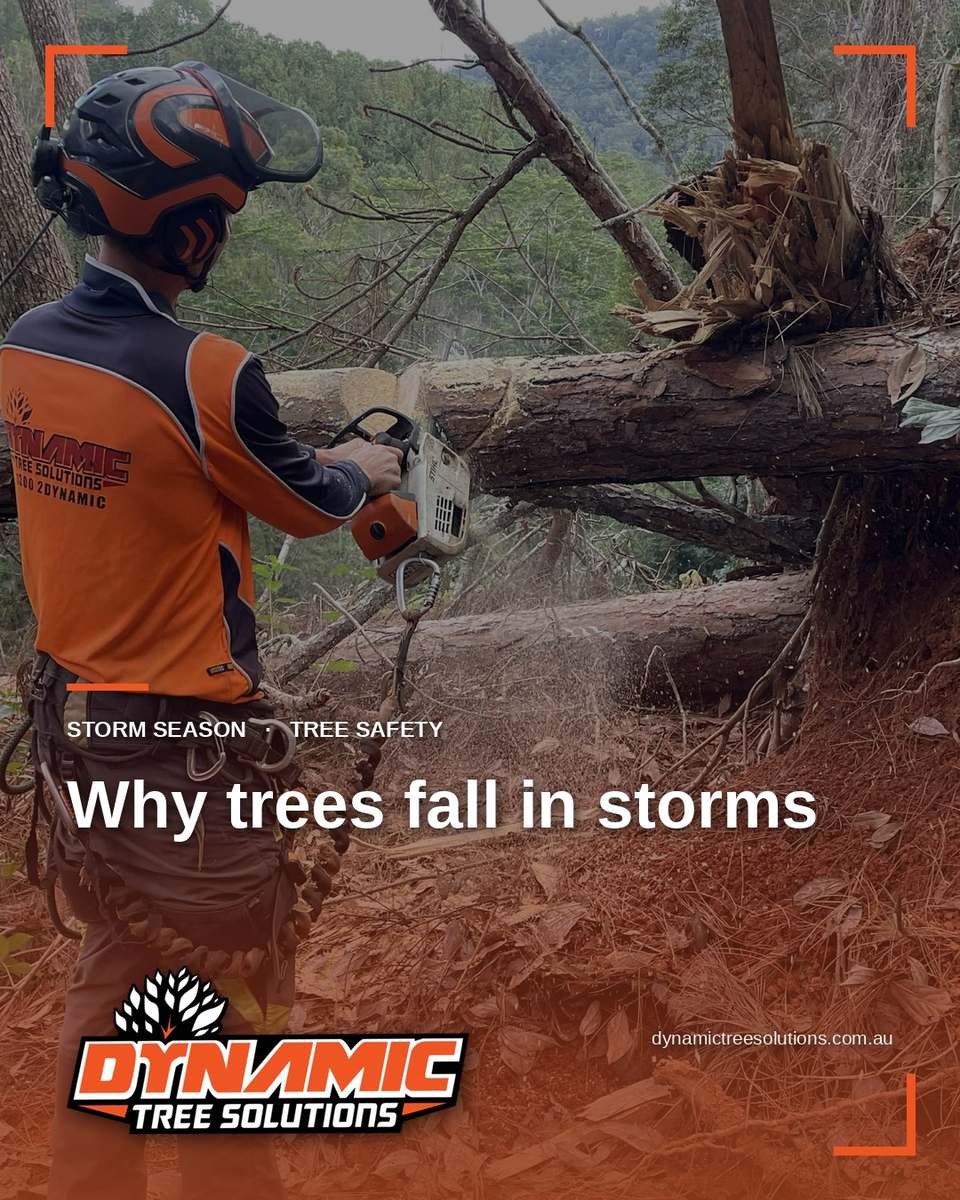
Trees falling in storms is rarely bad luck. A tree comes down when the wind pushing on the canopy beats whatever is holding it up, and that’s either the roots in the ground or the wood in the trunk. Around Brisbane the usual recipe is a few days of rain to soften the soil, then a storm front with gusts from a direction the tree isn’t braced for. The ones to worry about have damaged roots, a fresh lean, dead wood, twin trunks or an old lopping job.
That’s the short version. The rest of this is what we look for when we’re standing under one, and what you can check yourself from the back deck with a cuppa.
Why do trees fall in storms?
Think of a tree as a lever with a sail on top. The canopy catches the wind, the trunk is the lever, and the roots are the bloke on the other end trying to hold it down. The taller the tree and the fuller the canopy, the more force lands at the base.
When the wind wins, a tree fails in one of three ways:
- The roots let go. The whole tree tips over and lifts a plate of roots and soil with it. This is the one that takes out fences, sheds and bedrooms.
- The trunk snaps. Almost always at a weak point that was already there: a hollow, an old wound, termite damage, or a fork that was never properly joined.
- A limb tears out. By far the most common. Long heavy limbs, dead limbs, and the weak regrowth that follows a bad lopping job.
A healthy tree with sound roots in firm ground will bend a long way before any of that happens. Storms find the trees that already had a problem. Most of the time the problem was visible months earlier, if anyone had looked up.
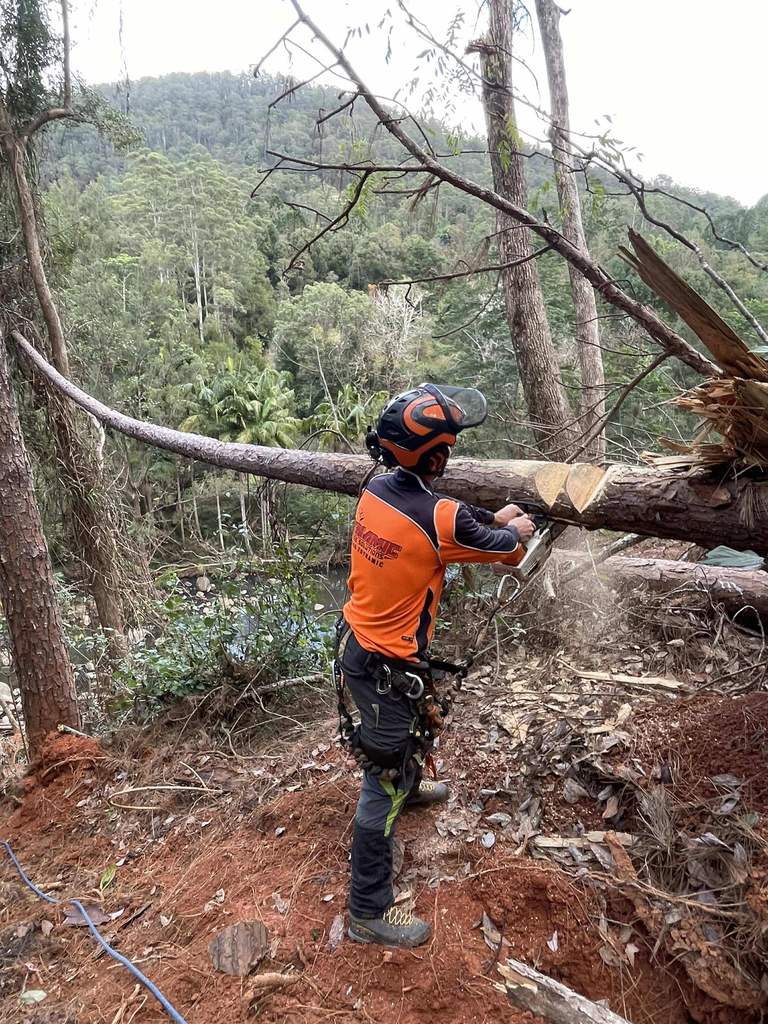
The photo above is from one of our storm clean-ups, on a steep red-soil slope. The tree didn’t go over at the roots. The trunk shattered partway up and dropped the whole top across the hill, so a job that would normally be done from a harness in the canopy turned into ground work with a big saw, one section at a time.
Why does wet soil make trees falling in storms more likely?
Because roots hold a tree up the same way a tent peg holds a tent. It’s grip, and grip needs firm ground.
Most of a tree’s roots are not deep. They sit in the top metre or so of soil and spread wide, often well past the edge of the canopy. In dry, firm ground that wide, shallow plate is very hard to shift. Soak the same ground for three or four days and clay turns to plasticine. The roots are all still there. They’ve just got nothing to hang on to.
That’s why the worst tree damage in South East Queensland often doesn’t come from the wildest wind. It comes when ordinary storm gusts hit ground that’s already full of water. Late in the season, when ex-cyclone rain has been sitting over us for days, we see whole trees go over in winds that wouldn’t have bothered them in October.
Wind direction matters too. A tree grows its strongest roots against the wind it gets most of the time. Storm cells don’t follow that rule. A hard gust from the “wrong” side loads roots that have never had to work.
Which trees are most likely to fall in a storm?
People want a list of bad species. Honestly, the species matters less than the condition of the tree and what’s been done around it. These are the ones that make us nervous:
- Trees with roots cut on one side. A new driveway, a trench for the NBN or plumbing, a pool, a retaining wall. Cut the roots on the windward side and the tree has lost its anchor rope.
- A lean that’s new. A tree that has always leaned has grown to suit it. A lean that turned up this year, or soil that’s cracked or lifting on one side of the base, means the root plate is already moving. We covered that in can you save a leaning tree.
- Twin trunks in a tight V. If two stems of the same size meet in a narrow fork with bark folded down into the join, they’re pressed together, not joined. That fork is where it will split.
- Dead wood, hollows and fungus. Bracket fungus at the base, mud tubes from termites, a hollow you can see into. All of them mean there is less wood holding the tree up than it looks like from the street.
- Trees that were topped years ago. The regrowth is long, heavy and hanging off the outside of an old wound. It’s the first thing to tear out. There’s more on why in our page on tree lopping in Brisbane.
- Trees that just lost their shelter. A tree that grew up in a group, then had its neighbours cleared for a new house or road, is suddenly taking wind it has never had to stand up to.
Where you live changes the odds as well. In the newer estates around Augustine Heights and Bellbird Park, a lot of trees are fast growers sitting in a thin layer of topsoil, with a slab, a fence and a driveway boxing the roots in. They put on height quickly and don’t have much to hold it with. On the older, bigger blocks out toward Yamanto it’s the opposite problem: mature gums carrying years of dead wood and the odd hollow nobody has looked at since the last owner.
As for species, gums are more likely to drop a limb than fall over, and they’ll do it in heat as well as wind. Big old jacarandas and African tulip trees have brittle wood and shed branches in a blow. None of that makes them bad trees. It makes them trees worth a look before storm season.
What do we find on storm callouts?
The same three stories, over and over.
One: the limb on the roof came off a tree that was lopped years back, by someone long gone. Two: the tree that went over whole had a trench or a driveway cut past it in the last couple of years. Three: the dead limb everyone had been meaning to deal with finally dealt with itself.
Not one of those is a freak event. That’s the good news. If the causes are that ordinary, most of them can be spotted and fixed on a quiet weekday instead of at 11 pm in the rain.
What should you check before the next storm?
Ten minutes, once a season, is enough to catch most of it:
- Walk around the base. Look for cracked or lifted soil, fungus growing out of the trunk or roots, and termite mud.
- Look up. Dead limbs, broken branches hung up in the canopy, and splits where big limbs or twin trunks meet.
- Check the lean. Line the trunk up against the house or a fence post and take a photo. Do it again next season and compare.
- Think about what’s changed. Any digging, paving or building near the tree? Any trees next door that have gone?
- Look at what’s underneath. A dodgy tree over the back paddock is a problem for later. The same tree over a bedroom or the service line is a problem for this week.
Our storm season tree checklist goes through the whole yard, gutters and all. Get Ready Queensland has the household side of it: emergency kit, plan, insurance.
If something on that list doesn’t look right, get it looked at properly. A visual tree assessment from a qualified arborist tells you whether the tree needs nothing, some dead-wooding and weight taken off, or whether it’s a dangerous tree that has to come out. Most of the time it’s the middle one.
What do you do if a tree has already come down?
- Stay away from it until you know nothing is touching a powerline. If a line is down or caught in the tree, keep well clear and call Energex on 13 19 62. Their advice is on the Energex trees and powerlines page.
- If it’s on the house, get everyone out of that part of the building. Call the SES on 132 500 for storm damage help, or 000 if anyone is in danger.
- Take photos before anything is moved. Your insurer will want them. We’ve written up what to do when a tree falls on your house step by step.
- Don’t start cutting. A fallen tree is loaded like a spring. Limbs under tension kick when they’re cut, and that’s how people get hurt on the clean-up, not in the storm.
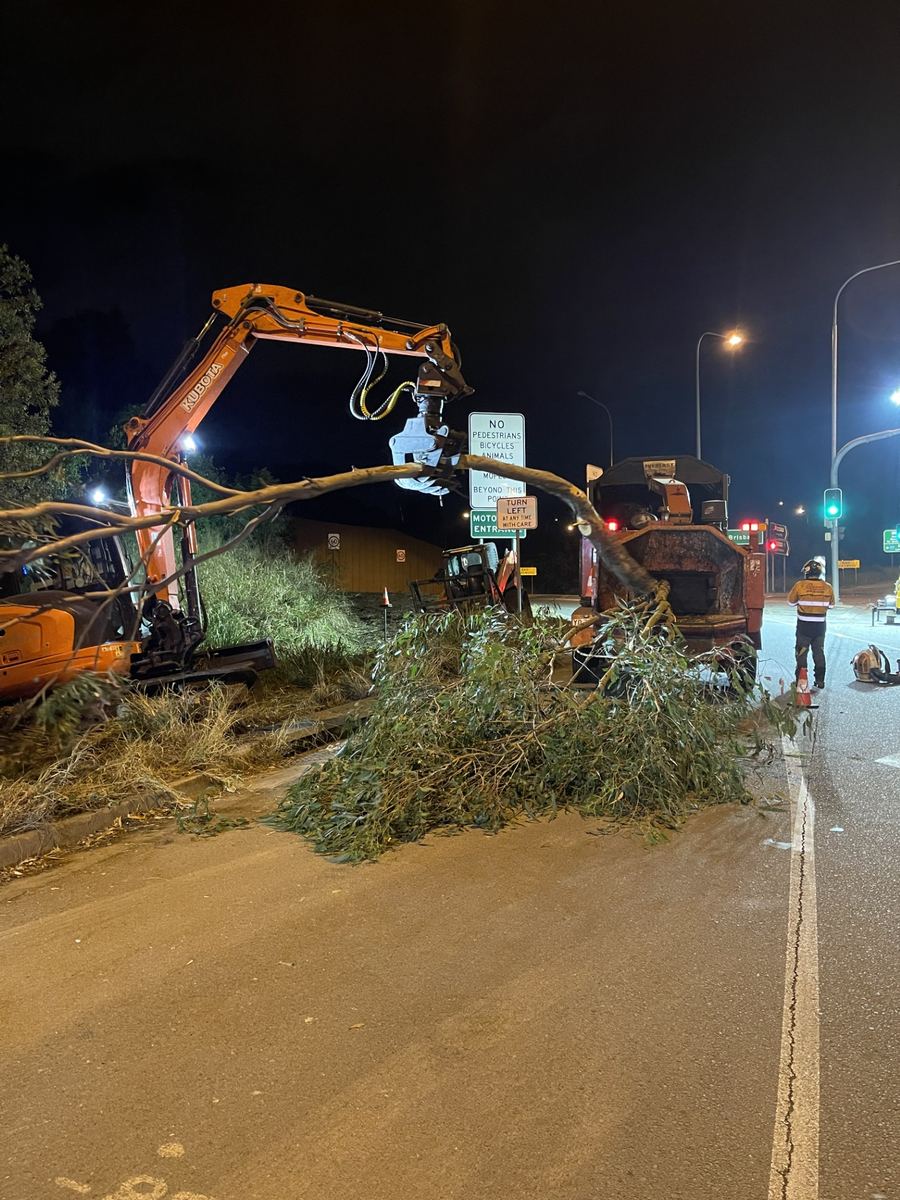
Then call us. Our crews do emergency tree removal across Brisbane, Logan and Ipswich through storm season, with the climbers, the excavator and the chipper to get it off the roof or the driveway and gone.
Got a tree you don’t trust? Call Dynamic Tree Solutions on 1300 239 626, or send a couple of photos through the quote form. It costs nothing to ask, and it beats finding out in February.
Frequently asked questions
Why do trees fall in storms?
A tree falls when the wind load on the canopy is more than the roots or the trunk can hold. Saturated soil loosens the roots' grip, and decay, old wounds, cut roots or a weak fork give the wind a place to break it. Healthy trees in firm ground rarely fall.
Do palm trees fall in storms?
Not often. A palm has a flexible trunk, a small crown and a dense ball of fibrous roots, so it bends and sheds fronds instead of going over. The ones that do fall usually have a rotted base or are sitting in waterlogged or undermined ground. Cocos palms will drop fronds and seed bunches in any decent blow.
Do pine trees fall in storms?
Some do. Norfolk Island pines and hoop pines have one straight trunk and tiered branches that let wind through, and they ride out most storms. The pines to watch are tall ones with a dead top, a lean or wet ground around the roots, because when a pine goes there is a lot of trunk to land.
Which way will a tree fall in a storm?
Usually downwind, but don't bet the house on it. A lean, a lopsided canopy or roots cut on one side can pull a tree in a different direction, and storm gusts in South East Queensland swing around as a cell passes. Treat anything within the tree's height as in range.
Are trees more likely to fall after heavy rain?
Yes. Most tree roots sit in the top metre of soil and hold by grip. After several days of rain the ground softens and the roots have less to hang on to, so a tree can go over in wind it would normally shrug off.
Can you tell if a tree is going to fall?
Often, yes. Warning signs are a new lean, cracked or lifting soil at the base, fungus or termite mud on the trunk, dead limbs, a split where twin trunks meet, and recent digging near the roots. An arborist can assess the tree and tell you whether it needs pruning, monitoring or removal.
